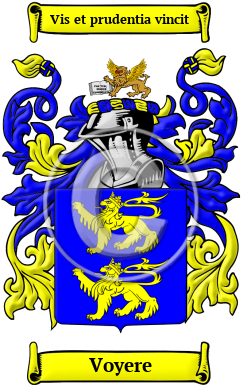
| ![Show Contents]() Voyere History, Family Crest & Coats of Arms Voyere History, Family Crest & Coats of Arms
- Origins Available:
France
Etymology of VoyereWhat does the name Voyere mean? The name Voyere dates back to the days of Medieval France, in the region of Brittany (French: Bretagne). It is derived from their residence in Brittany. Early Origins of the Voyere familyThe surname Voyere was first found in Brittany where this distinguished family held a family seat at Gripel and Penhoet, and were members of the aristocracy of that region. This distinguished family intermarried with the eminent family of d'Argenson and through this marriage they were elevated to the nobility as the Marquis d'Argenson seated at Paulny. Notables of this family were: Marc-René de Voyer, Comte d'Argenson 1623-1700; Pierre de Voyer, Viscomte d'Argenson, Governor of Canada, 1658; Marc-René de Voyer, Marquis d'Argenson, 1652-1721; René-Louis de Voyer, Marquis d'Argenson, 1694-1757; Marc-Pierre de Voyer, Comte d'Argenson, 1696-1764; Antoine-René de Voyer, Marquis de Paulmy d'Argenson, 1722-1787; Marc-René-Marie de Voyer, Marquis de Paulmy d'Argenson, 1771-1842. This family flourished on their estates until the French Revolution in 1789 when many aristocratic families lost their lands. 1 Pierre Voyer, born in 1630, travelled from France to Canada in the 17th century. After arriving in the province of Quebec he married Catherine Crampon, born in 1642, at Château-Richer on 1st December 1662. They remained together in Quebec until Pierre's death on 14th November 1695. Catherine passed away on 6th July 1699. 2 Early History of the Voyere familyThis web page shows only a small excerpt of our Voyere research. Another 20 words (1 lines of text) covering the years 1596 and 1651 are included under the topic Early Voyere History in all our PDF Extended History products and printed products wherever possible. Voyere Spelling VariationsFrench surnames were subject to numerous alterations in spelling because of the various cultural groups that inhabited specific regions. Eventually, each region possessed its own local dialect of the French language. The early development of the French language, however, was also influenced by other languages. For example, Old French was infused with Germanic words and sounds when barbarian tribes invaded and settled in France after the fall of the Roman Empire. Middle French also borrowed heavily from the Italian language during the Renaissance. As a result of these linguistic and cultural influences, the name Voyere is distinguished by a number of regional variations. The many spelling variations of the name include Voyer, Voier, Voyere, Voyez, Voyet, Voir, Voire, La Voyer, Lavoyer, Le Voyer and many more. Early Notables of the Voyere familyMore information is included under the topic Early Voyere Notables in all our PDF Extended History products and printed products wherever possible. Migration of the Voyere familyBy 1643 there were only about 300 people in Quebec. Since immigration was slow, early marriage was desperately encouraged amongst the immigrants. The fur trade attracted migrants, both noble and commoner. 15,000 explorers left Montreal in the late 17th and 18th centuries. By 1675, there were 7000 French in Quebec. By the same year the Acadian presence in Nova Scotia, New Brunswick and Prince Edward Island had reached 500. In 1755, 10,000 French Acadians refused to take an oath of allegiance to England and were deported to Louisiana. The French founded Lower Canada, thus becoming one of the two great founding nations of Canada. The distinguished family name Voyere has made significant contributions to the culture, arts, sciences and religion of France and New France. Amongst the settlers in North America with this distinguished name Voyere were Pierre Voyer arrived in Quebec in 1662 from Maine; Jacques Voyer arrived in Quebec in 1683 from Poitou; Mr. Voyer settled in Virginia.
The motto was originally a war cry or slogan. Mottoes first began to be shown with arms in the 14th and 15th centuries, but were not in general use until the 17th century. Thus the oldest coats of arms generally do not include a motto. Mottoes seldom form part of the grant of arms: Under most heraldic authorities, a motto is an optional component of the coat of arms, and can be added to or changed at will; many families have chosen not to display a motto.
Motto: Vis et prudentia vincit
Motto Translation: Strength and prudence conquers.
- Hozier, Charles D, and Antoine Bachelin-Delforenne. État présent De La Noblesse française (1883-1887): Contenant Le Distionnaire De La Noblesse Contemporaine Et Larmorial général De France, Dapres Les Manuscrits De Ch. D Hozier. Librairie Des Bibliophiles, 1884. Print.
- Olivier, Reginald L. Your Ancient Canadian Family Ties. Logan: The Everton Publishers, Inc., P.O. Box 368, 1972. Print
 |