| ![Show Contents]() Tomline History, Family Crest & Coats of Arms Tomline History, Family Crest & Coats of Arms
Etymology of TomlineWhat does the name Tomline mean? The Celtic origin of the name Tomline was long ago developed in Wales. This surname comes from the names Tam, Thom, and Tom, which are pet forms of the personal name Thomas. The surname Tomline features a double diminutive, formed from the suffixes -el and -in. 1 2 3 Early Origins of the Tomline familyThe surname Tomline was first found in Breconshire (Welsh: Sir Frycheiniog), a traditional county in southern Wales, which takes its name from the Welsh kingdom of Brycheiniog (5th-10th centuries), where they were conjecturally descended from Elystan Glodrydd, Prince of Fferllys, through Thomas of Llyn Madoc. Hence Tomlyn, in North Wales was commonly replaced by an 'a' hence Tamlyn. Early English rolls provide us a glimpse of the spelling variations used through Medieval times. Today we typically need to look beyond the spellings of these entries and concentrate on a phonetic appreciation of the names. Peter Tamelyn was listed in the Subsidy Rolls for Suffolk in 1327. 4 "The 14th - cent. English forms are Tomelyn, Thomelyn, Tomlyn, Thomlyn." 2 In Somerset, John Tomelyn and John Thomelyn were both listed there 1 Edward III (in the first year of King Edward III's reign.) 5 Early History of the Tomline familyThis web page shows only a small excerpt of our Tomline research. Another 57 words (4 lines of text) covering the years 1563, 1621, 1629, 1650, 1750, 1762, 1763, 1772, 1774, 1787, 1803, 1804, 1811, 1815, 1820, 1827, 1828, 1841 and 1872 are included under the topic Early Tomline History in all our PDF Extended History products and printed products wherever possible. Tomline Spelling VariationsAlthough there are comparatively few Welsh surnames, they have a great many spelling variations. Variations of Welsh names began almost immediately after their acceptance within Welsh society. In the Middle Ages, it was up to priests and the few other people that recorded names in official documents to decide how to spell the names that they heard. Variations that occurred because of improper recording increased dramatically as the names were later transliterated into English. The Brythonic Celtic language of Wales, known by natives as Cymraeg, featured many highly inflected sounds that could not be properly captured by the English language. Spelling variations were, however, also carried out according to an individual's design: a branch loyalty within the family, a religious adherence, or even patriotic affiliations were all indicated by the particular variation of one's name. The spelling variations of the name Tomline have included Tamblyn, Taplin, Tapling, Tomblyn, Tomlyn, Tomline and many more. Early Notables of the Tomline family- Sir George Pretyman Tomline (1750-1828), born George Pretyman, Bishop of Lincoln (1787-1820.) He was "tutor of the younger Pitt, and bishop of Winchester, was the son of George Pretyman of Bury St. Ed...
- the dying statesman's last instructions, under which the bishop was left literary executor, were taken down by Tomline and signed by Pitt (original document in the Orwell Collection), and his last wor...
| Tomline migration to the United States | + |
Many people from Wales joined the general migration to North America in the 19th and 20th centuries, searching for land, work, and freedom. Like the many other immigrants from the British Isles, they made a significant contribution to the development of Canada and the United States. The Welsh and their descendents added a rich cultural tradition to the newly developed towns, cities, and villages. An investigation of the immigration and passenger lists has revealed a number of people bearing the name Tomline:
Tomline Settlers in United States in the 17th Century- Edward Tomline, who landed in Maryland in 1669 6
| Contemporary Notables of the name Tomline (post 1700) | + |
- Sir George Pretyman Tomline (1750-1827), English tutor of the younger William Pitt, Bishop of Winchester, son of George Pretyman of Bury St. Edmunds
The motto was originally a war cry or slogan. Mottoes first began to be shown with arms in the 14th and 15th centuries, but were not in general use until the 17th century. Thus the oldest coats of arms generally do not include a motto. Mottoes seldom form part of the grant of arms: Under most heraldic authorities, a motto is an optional component of the coat of arms, and can be added to or changed at will; many families have chosen not to display a motto.
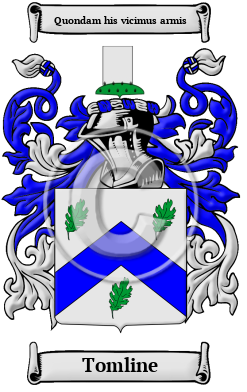
Motto: Quondam his vicimus armis
Motto Translation: We formerly conquered with these arms.
- Bardsley, C.W, A Dictionary of English and Welsh Surnames: With Special American Instances. Wiltshire: Heraldry Today, 1901. Print. (ISBN 0-900455-44-6)
- Harrison, Henry, Surnames of the United Kingdom: A Concise Etymological Dictionary Baltimore: Geneological Publishing Company, 2013. Print
- Smith, Eldson Coles, New Dictionary of American Family Names New York: Harper & Row, 1956. Print
- Reaney, P.H and R.M. Wilson, A Dictionary of English Surnames. London: Routledge, 1991. Print. (ISBN 0-415-05737-X)
- Dickinson, F.H., Kirby's Quest for Somerset of 16th of Edward the 3rd London: Harrison and Sons, Printers in Ordinary to Her Majesty, St, Martin's Lane, 1889. Print.
- Filby, P. William, Meyer, Mary K., Passenger and immigration lists index : a guide to published arrival records of about 500,000 passengers who came to the United States and Canada in the seventeenth, eighteenth, and nineteenth centuries. 1982-1985 Cumulated Supplements in Four Volumes Detroit, Mich. : Gale Research Co., 1985, Print (ISBN 0-8103-1795-8)
 |