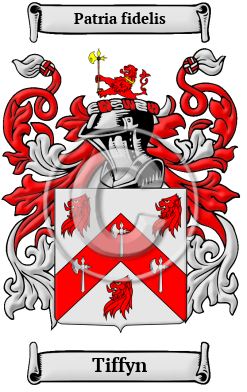
| ![Show Contents]() Tiffyn History, Family Crest & Coats of Arms Tiffyn History, Family Crest & Coats of Arms
- Origins Available:
England
Etymology of TiffynWhat does the name Tiffyn mean? Tiffyn is one of the thousands of new names that the Norman Conquest of 1066 brought to England. It comes from the medieval female given name Tiffania, that comes from the Greek Theophania, composed of the elements theos, meaning God and phainein meaning to appear. Tiffin translates roughly as the manifestation of God. 1 In a case where a man had a family by a second marriage the children of his second wife would occasionally take her name as a means of distinguishing the two groups. Early Origins of the Tiffyn familyThe surname Tiffyn was first found in Kent where the single names Theophania, Teffania, Theffanie all appeared in the Curia Regis Rolls for 1206. Later in Devon, Tiphina le Justiser was registered in 1322 and later again, Tiffania was found in Norfolk in 1323. Tiffan and Teffen both appear in the Yorkshire Poll Tax Rolls of 1379. As a surname, the first record we found as Gilbert Tyffayne in Norfolk in 1288. Later Cristina Typhayn was found in the Subsidy Rolls of Somerset in 1327 and later again, William Tyffen was found in the Subsidy Rolls for Suffolk in 1524. 2 The Yorkshire Poll Tax Rolls of 1379 include Johannes Holand et Tiffan uxor ejus; and Teffan Danyll. 1 Tiffany & Co., the luxury jewelry and specialty company in New York was named and founded in 1837 by Charles Lewis Tiffany (1812-1902), born in Killingly, Connecticut. Early History of the Tiffyn familyThis web page shows only a small excerpt of our Tiffyn research. Another 128 words (9 lines of text) covering the years 1536, 1540, 1632, 1690, 1695, 1750 and 1759 are included under the topic Early Tiffyn History in all our PDF Extended History products and printed products wherever possible. Tiffyn Spelling VariationsAnglo-Norman names tend to be marked by an enormous number of spelling variations. This is largely due to the fact that Old and Middle English lacked any spelling rules when Norman French was introduced in the 11th century. The languages of the English courts at that time were French and Latin. These various languages mixed quite freely in the evolving social milieu. The final element of this mix is that medieval scribes spelled words according to their sounds rather than any definite rules, so a name was often spelled in as many different ways as the number of documents it appeared in. The name was spelled Tiffen, Tiffin, Tiffing, Tiffine and others. Early Notables of the Tiffyn familyMore information is included under the topic Early Tiffyn Notables in all our PDF Extended History products and printed products wherever possible. Migration of the Tiffyn familyBecause of the political and religious discontent in England, families began to migrate abroad in enormous numbers. Faced with persecution and starvation at home, the open frontiers and generally less oppressive social environment of the New World seemed tantalizing indeed to many English people. The trip was difficult, and not all made it unscathed, but many of those who did get to Canada and the United States made important contributions to the young nations in which they settled. Some of the first North American settlers with Tiffyn name or one of its variants: Joseph Tiffen who landed in America in 1752; George Tiffin settled in Boston Massachusetts in 1822; Henry Tiffin settled in Philadelphia, Pennsylvania in 1830.
The motto was originally a war cry or slogan. Mottoes first began to be shown with arms in the 14th and 15th centuries, but were not in general use until the 17th century. Thus the oldest coats of arms generally do not include a motto. Mottoes seldom form part of the grant of arms: Under most heraldic authorities, a motto is an optional component of the coat of arms, and can be added to or changed at will; many families have chosen not to display a motto.
Motto: Patria fidelis
Motto Translation: A faithful country.
- Bardsley, C.W, A Dictionary of English and Welsh Surnames: With Special American Instances. Wiltshire: Heraldry Today, 1901. Print. (ISBN 0-900455-44-6)
- Reaney, P.H and R.M. Wilson, A Dictionary of English Surnames. London: Routledge, 1991. Print. (ISBN 0-415-05737-X)
 |