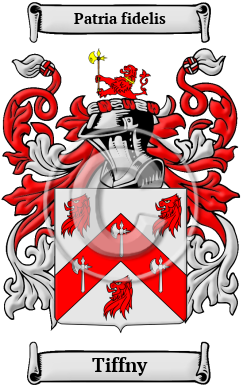
| ![Show Contents]() Tiffny History, Family Crest & Coats of Arms Tiffny History, Family Crest & Coats of Arms
- Origins Available:
England
Etymology of TiffnyWhat does the name Tiffny mean? The name Tiffny reached England in the great wave of migration following the Norman Conquest of 1066. It is based on the medieval female given name Tiffania, that comes from the Greek Theophania, composed of the elements theos, meaning God and phainein meaning to appear. Tiffin translates roughly as the manifestation of God. 1 In a case where a man had a family by a second marriage the children of his second wife would occasionally take her name as a means of distinguishing the two groups. Early Origins of the Tiffny familyThe surname Tiffny was first found in Kent where the single names Theophania, Teffania, Theffanie all appeared in the Curia Regis Rolls for 1206. Later in Devon, Tiphina le Justiser was registered in 1322 and later again, Tiffania was found in Norfolk in 1323. Tiffan and Teffen both appear in the Yorkshire Poll Tax Rolls of 1379. As a surname, the first record we found as Gilbert Tyffayne in Norfolk in 1288. Later Cristina Typhayn was found in the Subsidy Rolls of Somerset in 1327 and later again, William Tyffen was found in the Subsidy Rolls for Suffolk in 1524. 2 The Yorkshire Poll Tax Rolls of 1379 include Johannes Holand et Tiffan uxor ejus; and Teffan Danyll. 1 Tiffany & Co., the luxury jewelry and specialty company in New York was named and founded in 1837 by Charles Lewis Tiffany (1812-1902), born in Killingly, Connecticut. Early History of the Tiffny familyThis web page shows only a small excerpt of our Tiffny research. Another 128 words (9 lines of text) covering the years 1536, 1540, 1632, 1690, 1695, 1750 and 1759 are included under the topic Early Tiffny History in all our PDF Extended History products and printed products wherever possible. Tiffny Spelling VariationsThe English language only became standardized in the last few centuries. For that reason, spelling variations are common among many Anglo-Norman names. The shape of the English language was frequently changed with the introduction of elements of Norman French, Latin, and other European languages; even the spelling of literate people's names were subsequently modified. Tiffny has been recorded under many different variations, including Tiffen, Tiffin, Tiffing, Tiffine and others. Early Notables of the Tiffny familyMore information is included under the topic Early Tiffny Notables in all our PDF Extended History products and printed products wherever possible. Migration of the Tiffny familyTo escape the uncertainty of the political and religious uncertainty found in England, many English families boarded ships at great expense to sail for the colonies held by Britain. The passages were expensive, though, and the boats were unsafe, overcrowded, and ridden with disease. Those who were hardy and lucky enough to make the passage intact were rewarded with land, opportunity, and social environment less prone to religious and political persecution. Many of these families went on to be important contributors to the young nations of Canada and the United States where they settled. Tiffnys were some of the first of the immigrants to arrive in North America: Joseph Tiffen who landed in America in 1752; George Tiffin settled in Boston Massachusetts in 1822; Henry Tiffin settled in Philadelphia, Pennsylvania in 1830.
The motto was originally a war cry or slogan. Mottoes first began to be shown with arms in the 14th and 15th centuries, but were not in general use until the 17th century. Thus the oldest coats of arms generally do not include a motto. Mottoes seldom form part of the grant of arms: Under most heraldic authorities, a motto is an optional component of the coat of arms, and can be added to or changed at will; many families have chosen not to display a motto.
Motto: Patria fidelis
Motto Translation: A faithful country.
- Bardsley, C.W, A Dictionary of English and Welsh Surnames: With Special American Instances. Wiltshire: Heraldry Today, 1901. Print. (ISBN 0-900455-44-6)
- Reaney, P.H and R.M. Wilson, A Dictionary of English Surnames. London: Routledge, 1991. Print. (ISBN 0-415-05737-X)
 |