| ![Show Contents]() Tamlin History, Family Crest & Coats of Arms Tamlin History, Family Crest & Coats of Arms
Etymology of TamlinWhat does the name Tamlin mean? The Celtic origin of the name Tamlin was long ago developed in Wales. This surname comes from the names Tam, Thom, and Tom, which are pet forms of the personal name Thomas. The surname Tamlin features a double diminutive, formed from the suffixes -el and -in. 1 2 3 Early Origins of the Tamlin familyThe surname Tamlin was first found in Breconshire (Welsh: Sir Frycheiniog), a traditional county in southern Wales, which takes its name from the Welsh kingdom of Brycheiniog (5th-10th centuries), where they were conjecturally descended from Elystan Glodrydd, Prince of Fferllys, through Thomas of Llyn Madoc. Hence Tomlyn, in North Wales was commonly replaced by an 'a' hence Tamlyn. Early English rolls provide us a glimpse of the spelling variations used through Medieval times. Today we typically need to look beyond the spellings of these entries and concentrate on a phonetic appreciation of the names. Peter Tamelyn was listed in the Subsidy Rolls for Suffolk in 1327. 4 "The 14th - cent. English forms are Tomelyn, Thomelyn, Tomlyn, Thomlyn." 2 In Somerset, John Tomelyn and John Thomelyn were both listed there 1 Edward III (in the first year of King Edward III's reign.) 5 Early History of the Tamlin familyThis web page shows only a small excerpt of our Tamlin research. Another 57 words (4 lines of text) covering the years 1563, 1621, 1629, 1650, 1750, 1762, 1763, 1772, 1774, 1787, 1803, 1804, 1811, 1815, 1820, 1827, 1828, 1841 and 1872 are included under the topic Early Tamlin History in all our PDF Extended History products and printed products wherever possible. Tamlin Spelling VariationsAlthough there are not an extremely large number Welsh surnames, there are an inordinately large number of spelling variations of those surnames. This variety of spellings began almost immediately after the acceptance of surnames within Welsh society. As time progressed, these old Brythonic names were eventually were recorded in English. This process was problematic in that many of the highly inflected sounds of the native language of Wales could not be properly captured in English. Some families, however, did decide to modify their own names to indicate a branch loyalty within the family, a religious adherence, or even a patriotic affiliation. The name Tamlin has seen various spelling variations: Tamblyn, Taplin, Tapling, Tomblyn, Tomlyn, Tomline and many more. Early Notables of the Tamlin familyRichard Tomlins or Tomlyns (1563-1650), an English lawyer and politician who sat in the House of Commons between 1621 and 1629; and Sir George Pretyman Tomline (1750-1828), born George Pretyman, Bishop of Lincoln (1787-1820.) He was "tutor of the younger Pitt, and bishop of Winchester, was the son of George Pretyman of Bury St. Edmunds, by his wife Susan, daughter of John Hubbard. His father represented an ancient and respectable Suffolk family which had held land at Bacton in Suffolk from the fifteenth century. Tomline (who until 1803 bore the name of Pretyman) was born at Bury St. Edmunds on 9...
Another 176 words (13 lines of text) are included under the topic Early Tamlin Notables in all our PDF Extended History products and printed products wherever possible. Migration of the Tamlin familyThe Welsh migration to North America in the late 19th and early 20th centuries contributed greatly to its rapid development. These migrants were in search of land, work, and freedom. Those Welsh families that survived the long ocean journey were critical to the development of new industries and factories, and to the quick settlement of land. They also added to an ever-growing rich cultural heritage. A search of the immigration and passenger lists has shown a number of people bearing the name Tamlin: Henry Tomlin, who arrived in Virginia in 1638; Robert Tomlin arrived in Maryland in 1685; Matthew Tomlin arrived in Virginia in 1636; Sara Thomblin arrived in Virginia in 1650.
The motto was originally a war cry or slogan. Mottoes first began to be shown with arms in the 14th and 15th centuries, but were not in general use until the 17th century. Thus the oldest coats of arms generally do not include a motto. Mottoes seldom form part of the grant of arms: Under most heraldic authorities, a motto is an optional component of the coat of arms, and can be added to or changed at will; many families have chosen not to display a motto.
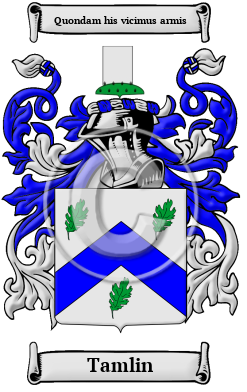
Motto: Quondam his vicimus armis
Motto Translation: We formerly conquered with these arms.
- Bardsley, C.W, A Dictionary of English and Welsh Surnames: With Special American Instances. Wiltshire: Heraldry Today, 1901. Print. (ISBN 0-900455-44-6)
- Harrison, Henry, Surnames of the United Kingdom: A Concise Etymological Dictionary Baltimore: Geneological Publishing Company, 2013. Print
- Smith, Eldson Coles, New Dictionary of American Family Names New York: Harper & Row, 1956. Print
- Reaney, P.H and R.M. Wilson, A Dictionary of English Surnames. London: Routledge, 1991. Print. (ISBN 0-415-05737-X)
- Dickinson, F.H., Kirby's Quest for Somerset of 16th of Edward the 3rd London: Harrison and Sons, Printers in Ordinary to Her Majesty, St, Martin's Lane, 1889. Print.
 |