| ![Show Contents]() Sullivent History, Family Crest & Coats of Arms Sullivent History, Family Crest & Coats of Arms
Etymology of SulliventWhat does the name Sullivent mean? The old Gaelic name used by the Sullivent family in Ireland was Ó Suileabhain, which is partially derived from the word "suil," which means "eye." The surname probably means either one-eyed or hawk-eyed. Early Origins of the Sullivent familyThe surname Sullivent was first found in the territory of Cahir in County Tipperary (Irish: Thiobraid Árann), established in the 13th century in South-central Ireland, in the province of Munster. The Sullivan spelling is by far the most common name in Munster, and is predominantly found in the counties of Cork and Kerry, with a smaller but still significant population in County Limerick. 1 Early History of the Sullivent familyThis web page shows only a small excerpt of our Sullivent research. Another 167 words (12 lines of text) covering the years 1172, 1560, 1590, 1618, 1660, 1700, 1710, 1745, 1784 and 1800 are included under the topic Early Sullivent History in all our PDF Extended History products and printed products wherever possible. Sullivent Spelling VariationsOne explanation for the many variations is that scribes and church officials frequently spelled the name as it sounded: an imprecise method at best. Understandably then, various spellings of the surname Sullivent were found in the many archives researched. These included O'Sullivan, Sullivan and others. Early Notables of the Sullivent familyDonall O'Sullivan Beare (1560-1618), Chief of the sept of his name in the district of Beare, co. Cork, who "engaged actively in the hostile movements in Ireland against the government of England in the last years of Queen Elizabeth." 2
Phillip O'Sullivan Beare (1590-1660), was a soldier in the Spanish army who is best remembered as a historian; and Colonel John O'Sullivan (b. 1700) was a companion to the "Young Pretender" who led the Irish Brigade at Culloden in 1745.
Owen Roe O'Sulliavan (1700?-1784) was Gaelic poet, called in Irish Eoghan Ruadh, or Red-haired Sullivan, was born about 1700 in Slieve Luachra, co...
Another 103 words (7 lines of text) are included under the topic Early Sullivent Notables in all our PDF Extended History products and printed products wherever possible. Migration of the Sullivent familyMany Irish families boarded ships bound for North America in the middle of 19th century to escape the conditions of poverty and racial discrimination at that time. Although these immigrants often arrived in a destitute state, they went on to make important contributions to the emerging nations of the United States and Canada. An inquiry into many immigration and passenger lists has revealed many early immigrants to North America bearing the Sullivent family name: Andrew, Arthur, Daniel, Denis, John, Michael, Patrick, Simon, Timothy and William O'Sullivan, who all arrived in Philadelphia between 1840 and 1860.
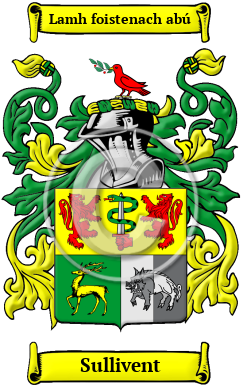
The motto was originally a war cry or slogan. Mottoes first began to be shown with arms in the 14th and 15th centuries, but were not in general use until the 17th century. Thus the oldest coats of arms generally do not include a motto. Mottoes seldom form part of the grant of arms: Under most heraldic authorities, a motto is an optional component of the coat of arms, and can be added to or changed at will; many families have chosen not to display a motto.
Motto: Lamh foistenach abú
Motto Translation: The steady hand to victory.
- MacLysaght, Edward, Irish Families Their Names, Arms and Origins 4th Edition. Dublin: Irish Academic, 1982. Print. (ISBN 0-7165-2364-7)
- Smith, George (ed), Dictionary of National Biography. London: Smith, Elder & Co., 1885-1900. Print
 |