| ![Show Contents]() Stroh History, Family Crest & Coats of Arms Stroh History, Family Crest & Coats of Arms
Etymology of StrohWhat does the name Stroh mean? The illustrious surname Stroh is classified as a habitation surname, which was originally derived from a place-name, and is one form of surname belonging to a broader group called hereditary surnames. Habitation names were derived from pre-existing names for towns, villages, parishes, or farmsteads. Topographic names, form the other broad category of surnames that was given to a person who resided near a physical feature such as a hill, stream, church, or type of tree.
Other local names are derived from the names of houses, manors, estates, regions, and entire counties. As a general rule, the greater the distance between an individual and their homeland, the larger the territory they were named after. For example, a person who only moved to another parish would be known by the name of their original village, while people who migrated to a different country were often known by the name of a region or country from which they came. Stroh is a place-name from in Stroud, a parish in Gloucestershire or from Strood, a parish in Kent. Early Origins of the Stroh familyThe surname Stroh was first found in Somerset where they were descended from the Alain, the Duke of Bretagne who arrived in England with William the Conqueror in 1066 A.D. The first to be granted lands was Sir Warinus Strode, Lord of Strode in Dorset, whose lands also pervaded Somerset. The Devon branch were originally from Strode, in the parish of Ermington, where Adam de Strode the first recorded ancestor was seated in the reign of Henry III. 1 Early History of the Stroh familyThis web page shows only a small excerpt of our Stroh research. Another 126 words (9 lines of text) covering the years 1249, 1290, 1350, 1360, 1400, 1480, 1522, 1561, 1589, 1597, 1598, 1600, 1624, 1626, 1637, 1638, 1643, 1645, 1660, 1666, 1676, 1685, 1689, 1690, 1707, 1750 and 1771 are included under the topic Early Stroh History in all our PDF Extended History products and printed products wherever possible. Stroh Spelling VariationsSince the Old and Middle English languages lacked definite spelling rules, Breton surnames have many spelling variations. Latin and French, which were the official court languages, were also influential on the spelling of surnames. The spelling of surnames was rarely consistent in medieval times, and scribes and church officials recorded names as they sounded rather than adhering to any specific spelling rules. Therefore, it was common to find the same individual referred to with different spellings of their surname in the ancient chronicles. Moreover, a large number of foreign names were brought into England after the Norman Conquest, which accelerated and accentuated the alterations to the spelling of various surnames. The name has been spelled Strode, Stroud, Strowd, Stroude, Strowde and others. Early Notables of the Stroh familyColonel Strode of Southhill; Ralph Strode (fl. 1350-1400), an English schoolman, fellow of Merton College, Oxford, before 1360; Sir Richard Strode (c. 1480-1522), English tinner and British Member of Parliament for Plympton Erle, Devon; and Richard Strode (1638-1707), British Member of Parliament for Plympton Erle from 1685-1689 and 1690; William Strode (1598-1645), an English politician who sat in the House of Commons of England between 1624 and 1645; William Strode (1600-1643)...
Another 70 words (5 lines of text) are included under the topic Early Stroh Notables in all our PDF Extended History products and printed products wherever possible. Stroh RankingIn the United States, the name Stroh is the 7,002nd most popular surname with an estimated 4,974 people with that name. 2
| Stroh migration to the United States | + |
Some of the first immigrants to cross the Atlantic and come to North America carried the name Stroh, or a variant listed above:
Stroh Settlers in United States in the 18th Century- Freiderich Stroh who settled in Pennsylvania in 1749
- Freiderich Stroh, who arrived in Pennsylvania in 1749 3
- Jost Stroh, who arrived in Pennsylvania in 1751 3
- Peter Stroh, who arrived in Pennsylvania in 1754 3
- Peter Stroh who took the "Oath of Allegiance" in 1754
- ... (More are available in all our PDF Extended History products and printed products wherever possible.)
Stroh Settlers in United States in the 19th Century- Frederic Stroh, aged 22, who landed in Philadelphia, Pennsylvania in 1804 3
- Adam Stroh, who arrived in St Clair County, Illinois in 1859 3
- Philip Stroh, who landed in St Clair County, Illinois in 1860 3
- Anne Marie Gottfried Stroh, who landed in America in 1866 3
- August Stroh, aged 30, who landed in New York, NY in 1889 3
- ... (More are available in all our PDF Extended History products and printed products wherever possible.)
| Stroh migration to Canada | + |
Stroh Settlers in Canada in the 19th Century- Johann and Christopher Stroh, who settled in Quebec with their many children
- Marga Stroh, aged 19, who arrived in Quebec in 1893
- Marga Stroh, aged 50, who landed in Quebec in 1893
- Maria Stroh, aged 7, who arrived in Quebec in 1893
- Maria Stroh, aged 11, who landed in Quebec in 1893
- ... (More are available in all our PDF Extended History products and printed products wherever possible.)
| Contemporary Notables of the name Stroh (post 1700) | + |
- Robert H. Stroh, American Republican politician, Candidate for U.S. Representative from Pennsylvania 11th District, 1948 4
- Kaycee Stroh (b. 1984), American actress, singer and dancer
- Wilfried Stroh (1939-2025), German philologist and academic
- Bernard Stroh, American founder of the Stroh Brewing Company of Detroit, Michigan
- Ken Stroh Ph.D., of the Los Alamos National Laboratory
- Johannes Matthias Augustus Stroh, German designer of violins, eponym of the Stroh violin
- Richard Stroh, Canadian television actor
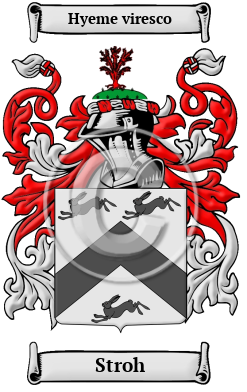
The motto was originally a war cry or slogan. Mottoes first began to be shown with arms in the 14th and 15th centuries, but were not in general use until the 17th century. Thus the oldest coats of arms generally do not include a motto. Mottoes seldom form part of the grant of arms: Under most heraldic authorities, a motto is an optional component of the coat of arms, and can be added to or changed at will; many families have chosen not to display a motto.
Motto: Hyeme viresco
Motto Translation: I flourish (or am green) in winter.
- Shirley, Evelyn Philip, The Noble and Gentle Men of England; The Arms and Descents. Westminster: John Bower Nichols and Sons, 1866, Print.
- "What are the 5,000 Most Common Last Names in the U.S.?". NameCensus.com, https://namecensus.com/last-names/
- Filby, P. William, Meyer, Mary K., Passenger and immigration lists index : a guide to published arrival records of about 500,000 passengers who came to the United States and Canada in the seventeenth, eighteenth, and nineteenth centuries. 1982-1985 Cumulated Supplements in Four Volumes Detroit, Mich. : Gale Research Co., 1985, Print (ISBN 0-8103-1795-8)
- The Political Graveyard: Alphabetical Name Index. (Retrieved 2016, January 26) . Retrieved from http://politicalgraveyard.com/alpha/index.html
 |