
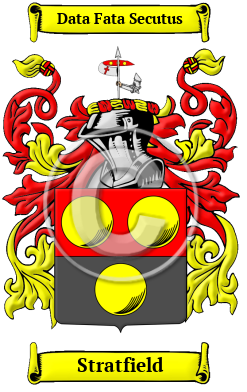
Show ContentsStratfield History, Family Crest & Coats of Arms

Etymology of Stratfield

What does the name Stratfield mean?

Stratfield is a name that was carried to England in the great wave of migration from Normandy following the Norman Conquest of 1066. The Stratfield family lived in Kent. Their name, however, is a reference to Estreville, Normandy, the family's place of residence prior to the Norman Conquest of England in 1066.

Early Origins of the Stratfield family

The surname Stratfield was first found in Kent. They were originally from Estreville in Normandy, and became known as De Stratavilla. They were Lords of the manor of Chiddingstone in that shire. One source claims "Among some papers preserved in the family, it is noted that an ancestor, travelling about a century since in Saxony, met with a family named Streightveldt, who bore the arms and crest of the Kentish Streatfeilds." 1 A couple of comments on this reference: as the book was written in 1860, one would presume that the author is referring to 1760; and secondly the reader should be aware that most "field" names were originally spelt "feild."

Early History of the Stratfield family

This web page shows only a small excerpt of our Stratfield research. Another 72 words (5 lines of text) are included under the topic Early Stratfield History in all our PDF Extended History products and printed products wherever possible.

Stratfield Spelling Variations

Before English spelling was standardized a few hundred years ago, spelling variations of names were a common occurrence. Elements of Latin, Norman French and other languages became incorporated into English throughout the Middle Ages, and name spellings changed even among the literate. The variations of the surname Stratfield include Streatfield, Streatfeild, Streetfield, Stratfield and others.

Early Notables of the Stratfield family

More information is included under the topic Early Stratfield Notables in all our PDF Extended History products and printed products wherever possible.


Stratfield migration to West Indies +

The British first settled the British West Indies around 1604. They made many attempts but failed in some to establish settlements on the Islands including Saint Lucia and Grenada. By 1627 they had managed to establish settlements on St. Kitts (St. Christopher) and Barbados, but by 1641 the Spanish had moved in and destroyed some of these including those at Providence Island. The British continued to expand the settlements including setting the First Federation in the British West Indies by 1674; some of the islands include Barbados, Bermuda, Cayman Island, Turks and Caicos, Jamaica and Belize then known as British Honduras. By the 1960's many of the islands became independent after the West Indies Federation which existed from 1958 to 1962 failed due to internal political conflicts. After this a number of Eastern Caribbean islands formed a free association. 2
Stratfield Settlers in West Indies in the 17th Century
  • H. Stratfield, who settled in Barbados in 1680


The Stratfield Motto +

The motto was originally a war cry or slogan. Mottoes first began to be shown with arms in the 14th and 15th centuries, but were not in general use until the 17th century. Thus the oldest coats of arms generally do not include a motto. Mottoes seldom form part of the grant of arms: Under most heraldic authorities, a motto is an optional component of the coat of arms, and can be added to or changed at will; many families have chosen not to display a motto.

Motto: Data Fata Secutus
Motto Translation: Following my destiny.


  1. Lower, Mark Anthony, Patronymica Britannica, A Dictionary of Family Names of the United Kingdom. London: John Russel Smith, 1860. Print.
  2. https://en.wikipedia.org/wiki/British_West_Indies


Houseofnames.com on Facebook