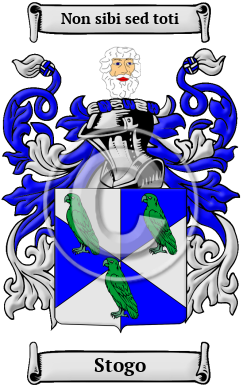
| ![Show Contents]() Stogo History, Family Crest & Coats of Arms Stogo History, Family Crest & Coats of Arms
Etymology of StogoWhat does the name Stogo mean? The name Stogo was brought to England in the great wave of migration following the Norman Conquest of 1066. The name Stogo is for a person whose profession was felling trees or removing tree stumps. The name was originally derived from the Old English word stocc, meaning tree stump. Early Origins of the Stogo familyThe surname Stogo was first found in Somerset where they were conjecturally descended from Walter de Douai, a Norman noble who was a Domesday tenant of Chilcompton, a village which two mills, 220 sheep, and 70 goats. 1 "The Stockers had a mansion-house near Chilcompton church, about a mile distant from Downside College. One of them had to compound for his estate with the Rump commissioners about the year 1651. I suspect F. Augustine Stoker, O.S.B., who died in London 18th August, 1668, was his kinsman. And I think that it was one of this family who told F. William Weston, as related in his Latin Auto biography, that at the plunder of Glastonbury he secured one of the nails, twelve inches long (with its case), which had been used at Christ's crucifixion. The nail itself, the instrument of wonderful cures. From this family, I suspect, came the piece of the true cross." 2 Early History of the Stogo familyThis web page shows only a small excerpt of our Stogo research. Another 93 words (7 lines of text) covering the years 1484, 1569 and 1592 are included under the topic Early Stogo History in all our PDF Extended History products and printed products wherever possible. Stogo Spelling VariationsBefore the last few hundred years the English language had no fixed system of spelling rules. For that reason, spelling variations occurred commonly in Anglo Norman surnames. Over the years, many variations of the name Stogo were recorded, including Stocker, Stoker, Stockere, Stokoe and others. Early Notables of the Stogo familyAnother 33 words (2 lines of text) are included under the topic Early Stogo Notables in all our PDF Extended History products and printed products wherever possible. Migration of the Stogo family to IrelandSome of the Stogo family moved to Ireland, but this topic is not covered in this excerpt. More information about their life in Ireland is included in all our PDF Extended History products and printed products wherever possible. Migration of the Stogo familyThe unstable environment in England at this time caused numerous families to board ships and leave in search of opportunity and freedom from persecution abroad in places like Ireland, Australia, and particularly the New World. The voyage was extremely difficult, however, and only taken at great expense. The cramped conditions and unsanitary nature of the vessels caused many to arrive diseased and starving, not to mention destitute from the enormous cost. Still opportunity in the emerging nations of Canada and the United States was far greater than at home and many went on to make important contributions to the cultures of their adopted countries. An examination of many early immigration records reveals that people bearing the name Stogo arrived in North America very early: William Stocker who settled in Virginia in 1623; William Stocker settled in Bermuda in 1635; Alexander Stocker settled in Carolina in 1751; Anna, Barbarba, Emanuel, George, Godfrey, John, George, Margerit, Maria, Michael, Peter Stocker all settled in Pennsylvania between 1731 and 1865.
The motto was originally a war cry or slogan. Mottoes first began to be shown with arms in the 14th and 15th centuries, but were not in general use until the 17th century. Thus the oldest coats of arms generally do not include a motto. Mottoes seldom form part of the grant of arms: Under most heraldic authorities, a motto is an optional component of the coat of arms, and can be added to or changed at will; many families have chosen not to display a motto.
Motto: Non sibi sed toti
Motto Translation: Not for one self but for all.
- Williams, Dr Ann. And G.H. Martin, Eds., Domesday Book A Complete Translation. London: Penguin, 1992. Print. (ISBN 0-141-00523-8)
- Oliver, George, Collections Illustrating the History of the Catholic Religion in the Counties of Cornwall, Devon, Dorset, Somerset, Wilts, and Gloucester London: Charles Dolman, 61, New Bond Street, 1857. Print
 |