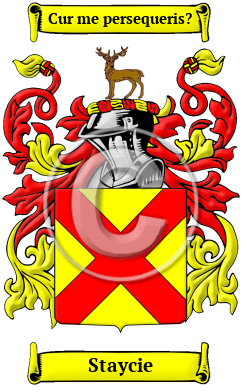
| ![Show Contents]() Staycie History, Family Crest & Coats of Arms Staycie History, Family Crest & Coats of Arms
- Origins Available:
Ireland
Etymology of StaycieWhat does the name Staycie mean? The Strongbownian invaders added their Norman conventions for surnames to the previously established Irish system for hereditary surnames. One of the most frequent forms of surnames for both cultures was the patronymic surname, which was formed from the name of the bearer's father or grandfather. The Norman tradition that the followers of Strongbow brought with them created such a surname through diminutive suffixes such as "-ot," "-et," "-un," "-in," or "-el." Occasionally, two suffixes were combined to form a double diminutive, as in the combinations of "-el-in," "-el-ot," "-in-ot," and "-et-in." The Normans also formed patronymic surnames in a manner very similar to the Irish: they added a prefix to their father's name. These Anglo-Norman people, however, used the prefix Fitz-, which was derived from the French word "fils," and ultimately from the Latin "filius," which both mean "son." Although this prefix probably originated in Flanders or Normandy, it can now only be found in Ireland. The surname Staycie is derived from the personal name Eustace. This name is derived from the Latin name "Eustacius," which in turn is derived from the distinct Greek names "Eustakhios," which means "fruitful," and "Eustathios," which means "orderly." Early Origins of the Staycie familyThe surname Staycie was first found in County Meath, Wicklow and Wexford. They were Barons of Meath and later became the Viscounts Baltinglass. Some of the family claim descent through the O'Briens and thereby the Heber Kings of Ireland. "Sir Roland Eustace, or Fitz Eustace, Lord Portlester, was descended from a branch or the Geraldines to whom Henry II. had granted the country round Nass. In 1454 he was appointed Deputy to Richard, Duke of York; and again in 1462 he filled the same office for the Duke of Clarence." (O'Hart) Stacey and its variants are a derivative of Eustace and are principally found in Wicklow and Wexford. 1 Early History of the Staycie familyThis web page shows only a small excerpt of our Staycie research. Another 166 words (12 lines of text) covering the years 1066, 1200, 1639 and 1702 are included under the topic Early Staycie History in all our PDF Extended History products and printed products wherever possible. Staycie Spelling VariationsSince church officials and medieval scribes spelt each name as it sounded to them; as a result, a single person could accumulate many different versions of his name within official records. A close examination of the origins of the name Staycie revealed the following spelling variations: FitzEustace, Eustace, Eustice, Eustis, Stacy, Stacey, Stasey, Stacie, Stacie, Staicey, Staycey and many more. Early Notables of the Staycie familyMore information is included under the topic Early Staycie Notables in all our PDF Extended History products and printed products wherever possible. Migration of the Staycie familyIreland's Great Potato Famine left the country's inhabitants in extreme poverty and starvation. Many families left their homeland for North America for the promise of work, freedom and land ownership. Although the Irish were not free of economic and racial discrimination in North America, they did contribute greatly to the rapid development of bridges, canals, roads, and railways. Eventually, they would be accepted in other areas such as commerce, education, and the arts. An examination of immigration and passenger lists revealed many bearing the name Staycie: James Eustis settled in Virginia in 1635; Mary Eustace settled in America in 1724; Alice Stacey settled in Barbados in 1664; Hugh Stacey settled in Salem, Mass in 1630.
The motto was originally a war cry or slogan. Mottoes first began to be shown with arms in the 14th and 15th centuries, but were not in general use until the 17th century. Thus the oldest coats of arms generally do not include a motto. Mottoes seldom form part of the grant of arms: Under most heraldic authorities, a motto is an optional component of the coat of arms, and can be added to or changed at will; many families have chosen not to display a motto.
Motto: Cur me persequeris?
Motto Translation: Why persecutest thou me?
- MacLysaght, Edward, Supplement to Irish Families. Baltimore: Genealogical Book Company, 1964. Print.
 |