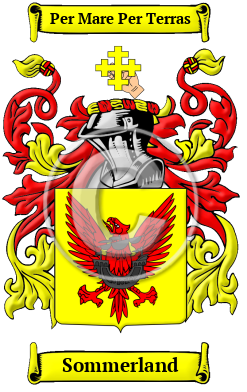
Show ContentsSommerland History, Family Crest & Coats of Arms

Etymology of Sommerland

What does the name Sommerland mean?

Sommerland is an ancient Viking-Scottish name for a the Old Norse word sumarlithi, which means mariner, Viking, summer wanderer, or sailor.

Early Origins of the Sommerland family

The surname Sommerland was first found in the island of South Uist, where they held a family seat from very ancient times, some say well before the Norman Conquest and the arrival of Duke William at Hastings in 1066 A.D. Descended from Somerled, King of the Vikings, scion of the MacDonald, Lord of the Isles, who died about 1057.

The first record of the name Somerled being used as a name was at Dunkeld, and the link between this person in 1169 and Somerled who had died 100 years before is not clear.

Another source notes that Sumerled or Somerled, Lord of the Isles (d. 1164), was "according to the Celtic tradition, the son of Gillebrede, son of Gilladoman, sixth in descent from Godfrey MacFergus, called in the Irish chronicle Toshach of the Isles; but some suppose him of Norse origin. " 1

Early History of the Sommerland family

This web page shows only a small excerpt of our Sommerland research. Another 128 words (9 lines of text) covering the years 1238 and 1400 are included under the topic Early Sommerland History in all our PDF Extended History products and printed products wherever possible.

Sommerland Spelling Variations

Sound and intuition were the main things that scribes in the Middle Ages relied on when spelling and translating names. Since those factors varied, so did the spelling of the names. Spelling variations of the name Sommerland include Somerled, M'Illurdy, M'Corle, M'Coull and many more.

Early Notables of the Sommerland family

More information is included under the topic Early Sommerland Notables in all our PDF Extended History products and printed products wherever possible.

Migration of the Sommerland family

In North America, the monarchy was thousands of miles away and Scots were free to settle on their own land and practice their own beliefs. The American War of Independence provided an opportunity for these settlers to pay back the English monarchy and forge a new nation. Recently, this heritage has survived through North American highland games and Clan societies. Early North American immigration and passenger lists have revealed a number of people bearing the name Sommerland or a variant listed above: John Somerled who arrived in Philadelphia, Pennsylvania in 1748.


The Sommerland Motto +

The motto was originally a war cry or slogan. Mottoes first began to be shown with arms in the 14th and 15th centuries, but were not in general use until the 17th century. Thus the oldest coats of arms generally do not include a motto. Mottoes seldom form part of the grant of arms: Under most heraldic authorities, a motto is an optional component of the coat of arms, and can be added to or changed at will; many families have chosen not to display a motto.

Motto: Per Mare Per Terras
Motto Translation: By sea and by land.


  1. Smith, George (ed), Dictionary of National Biography. London: Smith, Elder & Co., 1885-1900. Print


Houseofnames.com on Facebook