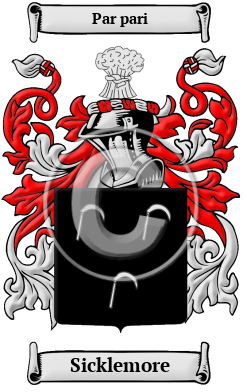
| ![Show Contents]() Sicklemore History, Family Crest & Coats of Arms Sicklemore History, Family Crest & Coats of Arms
- Origins Available:
England
Etymology of SicklemoreWhat does the name Sicklemore mean? Sicklemore is one of the thousands of new names that the Norman Conquest brought to England in 1066. The Sicklemore family lived in Suffolk. Their name, however, translates as the dweller by the sycamore trees. Early Origins of the Sicklemore familyThe surname Sicklemore was first found in Suffolk from very early times where they seated as Lords of the Manor of Wetheringsett. At the time of the taking of the Domesday Book in 1086 this village was the King's land, but was held by Godric and Ranulph, and conjecturally the Sicklemore family name is descended from this source. Early History of the Sicklemore familyThis web page shows only a small excerpt of our Sicklemore research. Another 121 words (9 lines of text) covering the years 1605, 1606, 1607 and 1610 are included under the topic Early Sicklemore History in all our PDF Extended History products and printed products wherever possible. Sicklemore Spelling VariationsMultitudes of spelling variations are a hallmark of Anglo Norman names. Most of these names evolved in the 11th and 12th century, in the time after the Normans introduced their own Norman French language into a country where Old and Middle English had no spelling rules and the languages of the court were French and Latin. To make matters worse, medieval scribes spelled words according to sound, so names frequently appeared differently in the various documents in which they were recorded. The name was spelled Sicklemore, Siklemore, Sicamour, Sicamore, Sickelmore, Sicklemour, Sicklemere and many more. Early Notables of the Sicklemore family- John Sicklemore (died 1610), Governor of Virginia, possibly connected with the Suffolk family of Sicklemore, which was originally settled at Bramford, near Ipswich. "In early life he changed his name...
| Sicklemore migration to the United States | + |
Because of this political and religious unrest within English society, many people decided to immigrate to the colonies. Families left for Ireland, North America, and Australia in enormous numbers, traveling at high cost in extremely inhospitable conditions. The New World in particular was a desirable destination, but the long voyage caused many to arrive sick and starving. Those who made it, though, were welcomed by opportunities far greater than they had known at home in England. Many of these families went on to make important contributions to the emerging nations of Canada and the United States. Analysis of immigration records indicates that some of the first North American immigrants bore the name Sicklemore or a variant listed above:
Sicklemore Settlers in United States in the 17th Century- Michael Sicklemore, who arrived in Jamestown, Va in 1607 1
- Michael Sicklemore was one of the first settlers in Virginia in 1608
| Sicklemore migration to West Indies | + |
The British first settled the British West Indies around 1604. They made many attempts but failed in some to establish settlements on the Islands including Saint Lucia and Grenada. By 1627 they had managed to establish settlements on St. Kitts (St. Christopher) and Barbados, but by 1641 the Spanish had moved in and destroyed some of these including those at Providence Island. The British continued to expand the settlements including setting the First Federation in the British West Indies by 1674; some of the islands include Barbados, Bermuda, Cayman Island, Turks and Caicos, Jamaica and Belize then known as British Honduras. By the 1960's many of the islands became independent after the West Indies Federation which existed from 1958 to 1962 failed due to internal political conflicts. After this a number of Eastern Caribbean islands formed a free association. 2Sicklemore Settlers in West Indies in the 17th Century- James Sicklemore, who arrived in Barbados with his servants in 1680
| Contemporary Notables of the name Sicklemore (post 1700) | + |
- Richard Sicklemore, English author of the book "Osrick"
- John Sicklemore, of Wetheringsett
The motto was originally a war cry or slogan. Mottoes first began to be shown with arms in the 14th and 15th centuries, but were not in general use until the 17th century. Thus the oldest coats of arms generally do not include a motto. Mottoes seldom form part of the grant of arms: Under most heraldic authorities, a motto is an optional component of the coat of arms, and can be added to or changed at will; many families have chosen not to display a motto.
Motto: Par pari
Motto Translation: Equal to my equal.
- Filby, P. William, Meyer, Mary K., Passenger and immigration lists index : a guide to published arrival records of about 500,000 passengers who came to the United States and Canada in the seventeenth, eighteenth, and nineteenth centuries. 1982-1985 Cumulated Supplements in Four Volumes Detroit, Mich. : Gale Research Co., 1985, Print (ISBN 0-8103-1795-8)
- https://en.wikipedia.org/wiki/British_West_Indies
 |