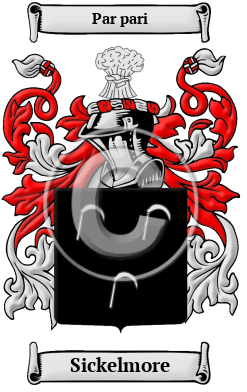
| ![Show Contents]() Sickelmore History, Family Crest & Coats of Arms Sickelmore History, Family Crest & Coats of Arms
- Origins Available:
England
Etymology of SickelmoreWhat does the name Sickelmore mean? The name Sickelmore was brought to England by the Normans when they conquered the country in 1066. The ancestors of the Sickelmore family lived in Suffolk. Their name, however, translates as the dweller by the sycamore trees. Early Origins of the Sickelmore familyThe surname Sickelmore was first found in Suffolk from very early times where they seated as Lords of the Manor of Wetheringsett. At the time of the taking of the Domesday Book in 1086 this village was the King's land, but was held by Godric and Ranulph, and conjecturally the Sicklemore family name is descended from this source. Early History of the Sickelmore familyThis web page shows only a small excerpt of our Sickelmore research. Another 121 words (9 lines of text) covering the years 1605, 1606, 1607 and 1610 are included under the topic Early Sickelmore History in all our PDF Extended History products and printed products wherever possible. Sickelmore Spelling VariationsIt is only in the last few hundred years that the English language has been standardized. For that reason, Anglo-Norman surnames like Sickelmore are characterized by many spelling variations. Scribes and monks in the Middle Ages spelled names they sounded, so it is common to find several variations that refer to a single person. As the English language changed and incorporated elements of other European languages such as Norman French and Latin, even literate people regularly changed the spelling of their names. The variations of the name Sickelmore include Sicklemore, Siklemore, Sicamour, Sicamore, Sickelmore, Sicklemour, Sicklemere and many more. Early Notables of the Sickelmore familyJohn Sicklemore (died 1610), Governor of Virginia, possibly connected with the Suffolk family of Sicklemore, which was originally settled at Bramford, near Ipswich. "In early life he changed his name to Ratcliffe. In 1605 a Captain Ratcliffe, who may have been identical with John Sicklemore, served in the English auxiliary force employed in the Netherlands under Sir Horace Vere, and was taken prisoner in October at the battle of Mulheim with Sir Henry Cary and Captain Pigott. On 20 Dec. 1606 he sailed from London in command of the Discovery, a pinnace of 20 tons, in...
Another 95 words (7 lines of text) are included under the topic Early Sickelmore Notables in all our PDF Extended History products and printed products wherever possible. Migration of the Sickelmore familyFaced with the chaos present in England at that time, many English families looked towards the open frontiers of the New World with its opportunities to escape oppression and starvation. People migrated to North America, as well as Australia and Ireland in droves, paying exorbitant rates for passages in cramped, unsafe ships. Many of the settlers did not make the long passage alive, but those who did see the shores of North America were welcomed with great opportunity. Many of the families that came from England went on to make essential contributions to the emerging nations of Canada and the United States. Some of the first immigrants to cross the Atlantic and come to North America carried the name Sickelmore, or a variant listed above: James Sicklemore arrived in Barbados with his servants in 1680; Michael Sicklemore was one of the first settlers in Virginia in 1608; twelve years before the ".
| Historic Events for the Sickelmore family | + |
Air New Zealand Flight 901 - Mr. David Brian Sickelmore (1959-1979), New Zealander Flight Steward, from Auckland, New Zealand working aboard the Air New Zealand sightseeing Flight 901 when it flew into Mount Erebus; he died in the crash 1
The motto was originally a war cry or slogan. Mottoes first began to be shown with arms in the 14th and 15th centuries, but were not in general use until the 17th century. Thus the oldest coats of arms generally do not include a motto. Mottoes seldom form part of the grant of arms: Under most heraldic authorities, a motto is an optional component of the coat of arms, and can be added to or changed at will; many families have chosen not to display a motto.
Motto: Par pari
Motto Translation: Equal to my equal.
- Mount Erebus, Memorial, Roll of Remembrance (Retrieved 2018, February 21st). Retrieved from http://www.erebus.co.nz/memorialandawards/rollofremembrance.aspx
 |