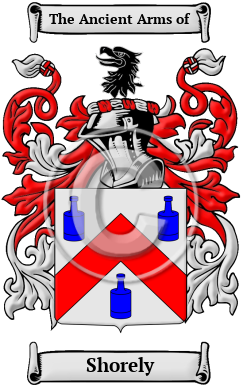
| ![Show Contents]() Shorely History, Family Crest & Coats of Arms Shorely History, Family Crest & Coats of Arms
- Origins Available:
England
Etymology of ShorelyWhat does the name Shorely mean? Shorely is one of the many names that the Normans brought with them when they conquered England in 1066. The Shorely family lived in Chorley, Lancashire, a market-town and parish, and the head of a union, in the hundred of Leyland. "The name of this place is derived from its situation on the river Chor, about a mile from its confluence with the Yarrow, and from the Saxon word Ley, a field; or from the family of Chorley, who were its ancient proprietors. The chief lordships of Chorley were subsequently held by the noble families of Ferrers and Lacy." 1 Early Origins of the Shorely familyThe surname Shorely was first found in Lancashire at Chorley. 2 We should now take a moment to explore the Cheshire branch of the family. It is generally believed that this was a latter branch as the first records there were found in the 16th century. Both townships there were originally held by the "Davenports from about the year 1400 until 1612, when it was purchased by the Downes family" and the "manor was possessed by the Harcourt family in the reign of Edward II., when the two coheiresses of Robert Harcourt married into the Cholmondeley family." 1 In Berkshire, Walter de Cherlelaie was listed in the Pipe Rolls for 1201 and later in Lancashire, Elias de Chorlegh was listed at Putnam in 1350. 3 The Wills at Chester listed Bridget Chorley, of Chorley, 1595 and John Chorley, of Chester, 1610. 4 Early History of the Shorely familyThis web page shows only a small excerpt of our Shorely research. Another 75 words (5 lines of text) covering the years 1719, 1807, 1808, 1830, 1867 and 1873 are included under the topic Early Shorely History in all our PDF Extended History products and printed products wherever possible. Shorely Spelling VariationsAnglo-Norman names tend to be marked by an enormous number of spelling variations. This is largely due to the fact that Old and Middle English lacked any spelling rules when Norman French was introduced in the 11th century. The languages of the English courts at that time were French and Latin. These various languages mixed quite freely in the evolving social milieu. The final element of this mix is that medieval scribes spelled words according to their sounds rather than any definite rules, so a name was often spelled in as many different ways as the number of documents it appeared in. The name was spelled Chorley, Chorly and others. Early Notables of the Shorely familyJosiah Chorley (d. 1719?), English Presbyterian minister, great-grandson of Richard Chorley of Walton-le-Dale, near Preston, Lancashire, and second of six sons of Henry Chorley of Preston. 5
Henry Fothergill Chorley was a journalist, author, and art critic, born Dec. 15, 1808, at Blackley Hurst, in Lancashire. "Sprung from an old Lancashire family, he had a self-willed, eccentric character, and an erratic temperament, common to most of its members, which accorded ill with the rigid tenets of the Society of Friends, to which they belonged. At 8 years of age he lost his father, and he received afterwards a somewhat desultory education, first...
Another 282 words (20 lines of text) are included under the topic Early Shorely Notables in all our PDF Extended History products and printed products wherever possible. Migration of the Shorely familyBecause of the political and religious discontent in England, families began to migrate abroad in enormous numbers. Faced with persecution and starvation at home, the open frontiers and generally less oppressive social environment of the New World seemed tantalizing indeed to many English people. The trip was difficult, and not all made it unscathed, but many of those who did get to Canada and the United States made important contributions to the young nations in which they settled. Some of the first North American settlers with Shorely name or one of its variants: Joseph Chorley who settled in Delaware Bay in 1683; Henry settled in Philadelphia in 1829; Joseph settled in Virginia in 1690; Charles arrived in New Orleans in 1820..
- Lewis, Samuel, A Topographical Dictionary of England. Institute of Historical Research, 1848, Print.
- Lower, Mark Anthony, Patronymica Britannica, A Dictionary of Family Names of the United Kingdom. London: John Russel Smith, 1860. Print.
- Reaney, P.H and R.M. Wilson, A Dictionary of English Surnames. London: Routledge, 1991. Print. (ISBN 0-415-05737-X)
- Bardsley, C.W, A Dictionary of English and Welsh Surnames: With Special American Instances. Wiltshire: Heraldry Today, 1901. Print. (ISBN 0-900455-44-6)
- Smith, George (ed), Dictionary of National Biography. London: Smith, Elder & Co., 1885-1900. Print
 |