| ![Show Contents]() Sheavas History, Family Crest & Coats of Arms Sheavas History, Family Crest & Coats of Arms
- Origins Available:
Scotland
Ireland
Etymology of SheavasWhat does the name Sheavas mean? The chronicles of the Sheavas family show that the name was first used in the Scottish/English Borderlands by the Strathclyde-Britons. It was a name for a person who lived in the old barony in the parish of Tarves, Aberdeenshire. The name Sheavas comes from Gaelic seamhas, meaning "a narrow place in a river." Early Origins of the Sheavas familyThe surname Sheavas was first found in Tarves, Aberdeenshire. Some of the earliest records of the family include: John Chivas, who had a safe conduct to study at Oxford in 1393, and William Shivas, who was a Physician and Astrologer, Archbishop of St. Andrews in 1477. Later, John Scheves was forgiven on a charge of murder in 1526. 1 William Schevez or Schives (died 1497) was "Archbishop of St. Andrews, is supposed to have descended from a family that adopted the name from the estate of Schevez in Aberdeenshire. One John de Schevez was clerk to James I in 1426, and may have been the patron through whose influence William Schevez was introduced to the court." 2 Early History of the Sheavas familyThis web page shows only a small excerpt of our Sheavas research. Another 115 words (8 lines of text) covering the years 1647, 1648, 1759, 1801, 1843 and 1850 are included under the topic Early Sheavas History in all our PDF Extended History products and printed products wherever possible. Sheavas Spelling VariationsThe origin of rules governing the spelling of names and even words is a very recent innovation. Before that, words and names were spelled according to sound, and, therefore, often appeared under several different spelling variations in a single document. Sheavas has been spelled Shivas, Shives, Chivas, Shivis, Shivez, Shivers, Shevas and many more. Early Notables of the Sheavas familyAnother 31 words (2 lines of text) are included under the topic Early Sheavas Notables in all our PDF Extended History products and printed products wherever possible. Migration of the Sheavas family to IrelandSome of the Sheavas family moved to Ireland, but this topic is not covered in this excerpt.
Another 33 words (2 lines of text) about their life in Ireland is included in all our PDF Extended History products and printed products wherever possible. Migration of the Sheavas familyThe persecution faced in their homeland left many Scots with little to do but sail for the colonies of North America. There they found land, freedom, opportunity, and nations in the making. They fought for their freedom in the American War of Independence, or traveled north to Canada as United Empire Loyalists. In both cases, they made enormous contributions to the formation of those great nations. Among them: Samuel Shiva who was on record in Boston Massachusetts in 1651; Richard Shevers, who was in the records of the Commonwealth of Massachusetts in 1694; James and Henry Shivers, who arrived in Philadelphia in 1847.
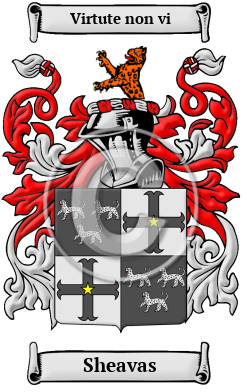
The motto was originally a war cry or slogan. Mottoes first began to be shown with arms in the 14th and 15th centuries, but were not in general use until the 17th century. Thus the oldest coats of arms generally do not include a motto. Mottoes seldom form part of the grant of arms: Under most heraldic authorities, a motto is an optional component of the coat of arms, and can be added to or changed at will; many families have chosen not to display a motto.
Motto: Virtute non vi
Motto Translation: By virtue not by force.
- Black, George F., The Surnames of Scotland Their Origin, Meaning and History. New York: New York Public Library, 1946. Print. (ISBN 0-87104-172-3)
- Smith, George (ed), Dictionary of National Biography. London: Smith, Elder & Co., 1885-1900. Print
 |