| ![Show Contents]() Rutterford History, Family Crest & Coats of Arms Rutterford History, Family Crest & Coats of Arms
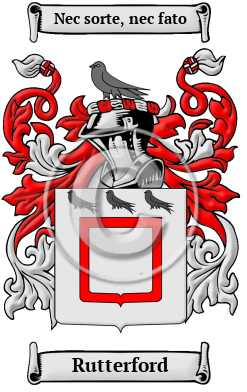
Etymology of RutterfordWhat does the name Rutterford mean? The annals of Scottish history suggest that the ancestors of the name Rutterford lived among the Boernician tribe of the Scottish-English border region. The Rutterford family lived in the Parish of Maxton, where Rutherford was a town, near Roxburghshire. The toponym Rutherford is derived from the Old English words hryder meaning cattle and ford, a shallow part of a river. Rutterford Coat of Arms CreationThe Rutherfords were a very important Border family, and as a crest they had a martlet (a swallow) with the motto, "Nec sorte nec fato" (Neither by chance nor fate). In their arms they had three martlets to show that some of the heads of the family had been in the Crusades, because just as swallows were birds of passage so were Crusaders. When in arms these birds are shown wanting beaks and feet, it means that those having such were maimed and wounded in these wars. The martlet, when shown by younger sons of a family, meant that they had to trust to the wings of virtue and merit, as they had no land of their own to set their feet on. There are two traditions as to the origin of the name. The first is that a man who guided Ruther, a King of the Scots, across the Tweed at a certain place to England was afterwards called Rutherford. Another story is that the English once tried to cross this river, but were set upon by the Scots, and it was for them a case of " rue-the-ford," which name was given to the place and its owner, and so it came about that there was a " Rutherford of that Ilk." 1 Early Origins of the Rutterford familyThe surname Rutterford was first found in the Parish of Maxton, town of Rutherford, county Roxburghshire. The first bearers of Rutterford on record were two knights: Gregory and Nicholas de Rutherford who were listed in the reigns of William the Lion and Alexander II. About the same time, Sir Richard, lord of Rotherford was listed as was William de Rwthirford, a cleric who witnessed a charter by Henry de Grahame. Nicholas de Rothirford, knight, rendered homage to King Edward I of England at Montrose in 1296, as did Margarete la fielle Nicol de Rotherforde who also rendered homage for her lands. 2 Early History of the Rutterford familyThis web page shows only a small excerpt of our Rutterford research. Another 284 words (20 lines of text) covering the years 1165, 1200, 1215, 1249, 1285, 1296, 1361, 1411, 1413, 1448, 1451, 1493, 1506, 1552, 1577, 1580, 1582, 1600, 1661, 1664, 1695, 1779 and 1890 are included under the topic Early Rutterford History in all our PDF Extended History products and printed products wherever possible. Rutterford Spelling VariationsIn the Middles Ages scribes spelled names by their sound. Often a name was written under a different spelling variation each time it was recorded. Rutterford has appeared as Rudfard, Ruterford, Rudforde, Rudfithy, Rudforthy, Rudforthe, Rudfith, Rudforth, Rudfearde, Rudfarte, Rudfarde, Rudferd, Rutherfard, Rudfart, Rutherfart, Ruddefork, Ruddeforde, Ruddeford, Ruddefithy and many more. Early Notables of the Rutterford familySamuel Rutherford (1600-1661), Scottish principal of St. Mary's College, St. Andrews, born about 1600 in the parish of Nisbet, now part of Crailing, Roxburghshire. 3
Andrew Rutherford (d. 1664), was a Scottish soldier of fortune, created 1st and only Earl of Teviot by Charles II; and Samuel Rutherford (ca. 1600-1661), a Scottish theologian and controversialist, born at Nisbet, Roxburghshire, educated at Edinburgh University, where he became a Professor of Latin.
John Rutherford (died 1577) was a...
Another 73 words (5 lines of text) are included under the topic Early Rutterford Notables in all our PDF Extended History products and printed products wherever possible. Migration of the Rutterford family to IrelandSome of the Rutterford family moved to Ireland, but this topic is not covered in this excerpt.
Another 60 words (4 lines of text) about their life in Ireland is included in all our PDF Extended History products and printed products wherever possible. Migration of the Rutterford familyThe ancestors of Boernician-Scottish settlers dot North America even today. They settled all along the east coast when they came over, but some went north as United Empire Loyalists at the time of the War of Independence. However, these strong lines endured as Scottish families in the United States and Canada have rediscovered much of the heritage that was taken from them centuries ago. Some of the first immigrants to cross the Atlantic and come to North America carried the name Rutterford, or a variant listed above: Henry Rutherford, who arrived in Connecticut in 1641; Gaven Rutherford, who came to Maryland in 1670; Dennis Rutherford, who settled in Pennsylvania in 1682.
The motto was originally a war cry or slogan. Mottoes first began to be shown with arms in the 14th and 15th centuries, but were not in general use until the 17th century. Thus the oldest coats of arms generally do not include a motto. Mottoes seldom form part of the grant of arms: Under most heraldic authorities, a motto is an optional component of the coat of arms, and can be added to or changed at will; many families have chosen not to display a motto.
Motto: Nec sorte, nec fato
Motto Translation: Neither by chance nor destiny.
- Polson, Alexander, The Romance of Scottish Crests and Mottoes. Inverness: Walter Alexander, Inglis Street 1929. Print
- Black, George F., The Surnames of Scotland Their Origin, Meaning and History. New York: New York Public Library, 1946. Print. (ISBN 0-87104-172-3)
- Smith, George (ed), Dictionary of National Biography. London: Smith, Elder & Co., 1885-1900. Print
 |