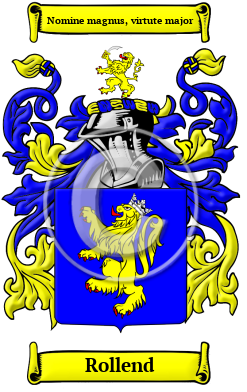
| ![Show Contents]() Rollend History, Family Crest & Coats of Arms Rollend History, Family Crest & Coats of Arms
- Origins Available:
France
Etymology of RollendWhat does the name Rollend mean? The name Rollend is from that ancient region of France known as Brittany. This particular name is derived from the old Germanic personal name Hrodlant, which is composed of the Old German elements hrod, meaning fame or victory, and lant, meaning land or territory. Early Origins of the Rollend familyThe surname Rollend was first found in Brittany, where the family has held a family seat since ancient times. Early History of the Rollend familyThis web page shows only a small excerpt of our Rollend research. Another 310 words (22 lines of text) covering the years 1268, 1510, 1642, 1678, 1786 and 1867 are included under the topic Early Rollend History in all our PDF Extended History products and printed products wherever possible. Rollend Spelling VariationsChanges of spelling have occurred in most surnames. The earliest explanation is that during the early development of the French language, names were not yet fixed in spelling. Usually a person gave his version of his name, phonetically, to a scribe, a priest, or a recorder. This depended on accent, and local accents frequently changed the spelling of a name. Some variables were adopted by different branches of the family name. Hence, there are some spelling variations of the name Rollend, including Rolland, Roland, Rollan, Rolan, Rolend, Rollend, Rollen, Rauland, Raulend, Rolain, Rollain, Raullen, Raullan, Raulan, Rolands, Rollands, Roling and many more. Early Notables of the Rollend familyAnother 33 words (2 lines of text) are included under the topic Early Rollend Notables in all our PDF Extended History products and printed products wherever possible. Migration of the Rollend familyMigration from France to New France or Quebec as it was now more popularly called, continued from France until it fell in 1759. By 1675, there were 7000 French in Quebec. By the same year the Acadian presence in Nova Scotia, New Brunswick and Prince Edward Island had reached 500. In the treaty of Utrecht, the Acadians were ceded by France to Britain in 1713. In 1755, 10,000 French Acadians refused to take an oath of allegiance to England and were deported. They found refuge in Louisiana. In 1793, the remaining French in these provinces came under British rule. Meanwhile, in Quebec, the French race flourished, founding in Lower Canada, one of the two great solitudes which became Canada. Many of this distinguished family name Rollend were prominent in social, cultural, religious and political affairs in France and New France. Amongst the settlers in North America with this distinguished name Rollend were Joseph Rolland, who settled in Louisiana in 1756; Jacques Rolland, aged 18; settled in Louisiana in 1719; John Rolland settled in Virginia in 1653; Francis Roland settled in Virginia in 1656.
The motto was originally a war cry or slogan. Mottoes first began to be shown with arms in the 14th and 15th centuries, but were not in general use until the 17th century. Thus the oldest coats of arms generally do not include a motto. Mottoes seldom form part of the grant of arms: Under most heraldic authorities, a motto is an optional component of the coat of arms, and can be added to or changed at will; many families have chosen not to display a motto.
Motto: Nomine magnus, virtute major
 |