| ![Show Contents]() Raglend History, Family Crest & Coats of Arms Raglend History, Family Crest & Coats of Arms
Etymology of RaglendWhat does the name Raglend mean? The Raglend surname comes from the historic village of Raglan (Welsh: Rhaglan) in Monmouthshire, known for its castle. Early Origins of the Raglend familyThe surname Raglend was first found in Monmouthshire (Welsh: Sir Fynwy), where they held a family seat from early times and their first records appeared on the early census rolls taken by the early Kings of Britain to determine the rate of taxation of their subjects. Early History of the Raglend familyThis web page shows only a small excerpt of our Raglend research. Another 79 words (6 lines of text) covering the years 1513, 1550, 1563 and 1578 are included under the topic Early Raglend History in all our PDF Extended History products and printed products wherever possible. Raglend Spelling VariationsAlthough there are comparatively few Welsh surnames, they have a great many spelling variations. Variations of Welsh names began almost immediately after their acceptance within Welsh society. In the Middle Ages, it was up to priests and the few other people that recorded names in official documents to decide how to spell the names that they heard. Variations that occurred because of improper recording increased dramatically as the names were later transliterated into English. The Brythonic Celtic language of Wales, known by natives as Cymraeg, featured many highly inflected sounds that could not be properly captured by the English language. Spelling variations were, however, also carried out according to an individual's design: a branch loyalty within the family, a religious adherence, or even patriotic affiliations were all indicated by the particular variation of one's name. The spelling variations of the name Raglend have included Raglan, Ragland and others. Early Notables of the Raglend familySir John Ragland of Carnllwyd, (died by 1550); and his son, Sir Thomas Ragland (fl.1563), of Carnllwyd, Glamorganshire, Wales and Roughton Holme, Norfolk and Walworth, Surrey, England, Justice of the Peace of Norfolk from 1550 and Member of the Parliament of England for Malmesbury in...
Another 45 words (3 lines of text) are included under the topic Early Raglend Notables in all our PDF Extended History products and printed products wherever possible. Migration of the Raglend familyMany people from Wales joined the general migration to North America in the 19th and 20th centuries, searching for land, work, and freedom. Like the many other immigrants from the British Isles, they made a significant contribution to the development of Canada and the United States. The Welsh and their descendents added a rich cultural tradition to the newly developed towns, cities, and villages. An investigation of the immigration and passenger lists has revealed a number of people bearing the name Raglend: Thomas Ragland, who arrived in Maryland in 1680; and John Ragland, his wife Ann Beaufort, and ten children, who came to Virginia in 1720.
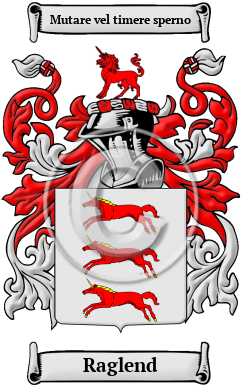
The motto was originally a war cry or slogan. Mottoes first began to be shown with arms in the 14th and 15th centuries, but were not in general use until the 17th century. Thus the oldest coats of arms generally do not include a motto. Mottoes seldom form part of the grant of arms: Under most heraldic authorities, a motto is an optional component of the coat of arms, and can be added to or changed at will; many families have chosen not to display a motto.
Motto: Mutare vel timere sperno
Motto Translation: I scorn to change or fear.
 |