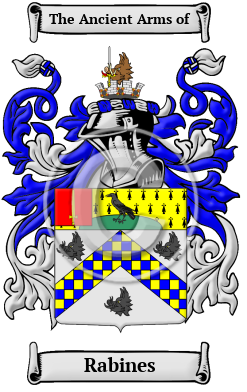
| ![Show Contents]() Rabines History, Family Crest & Coats of Arms Rabines History, Family Crest & Coats of Arms
- Origins Available:
England
Early Origins of the Rabines familyThe surname Rabines was first found in Dorset. A variety of spelling were first used upon their arrival to England including Raband, Rabayne and Roboin. "The family of De Rabayne came from Saintonge, Acquitaine, where it possessed the marquisate of Piscay. The castle of Rabaine still remains. The family was of eminence in 1018 (Des Bois)." 1 "The first who was of much note in England was Elias de Rabayne, a good soldier in the Gascon war of 1251, and high in favour with Henry III. In 1255 the King committed to him "the corpus of the Castle of Corfe during pleasure, saving to the King the warren, forest, and all other things pertaining to the Castle, outside the walls thereof." Considerable privileges were attached to this office, which the new Constable enforced and extended with such vigour that his aggrieved neighbours were driven to seek redress in the law courts. " 2 "Peter de Rabayne held Litde Pidele at his death in 1272; and 'Petrus de Roboin' is incontestably entered in the Testa de Nevill as holding Waybayouse of the King. 3 He was also possessed of Edmondesham, where he granted an annuity to John Beauboys (Bello Bosco) and his heirs. In 1316, Matilda de Rabayne was Lady of Edmondesham; but of her or her marriage we hear nothing more." 2 Later, Gloucestershire would be another home to the family as here Raban the Englishman, gave land to the church of St. Peter in Gloucester in 1150. Early History of the Rabines familyThis web page shows only a small excerpt of our Rabines research. Another 59 words (4 lines of text) covering the years 1273, 1622 and 1658 are included under the topic Early Rabines History in all our PDF Extended History products and printed products wherever possible. Rabines Spelling VariationsIt is only in the last few hundred years that the English language has been standardized. For that reason, Anglo-Norman surnames like Rabines are characterized by many spelling variations. Scribes and monks in the Middle Ages spelled names they sounded, so it is common to find several variations that refer to a single person. As the English language changed and incorporated elements of other European languages such as Norman French and Latin, even literate people regularly changed the spelling of their names. The variations of the name Rabines include Raban, Raben, de Raban, de Raben, Rabyn and others. Early Notables of the Rabines familyEdward Raban (died 1658), English-born, printer in Aberdeen who was said to have been a native of Worcestershire. While there is no direct evidence of his birth place, in his...
Another 30 words (2 lines of text) are included under the topic Early Rabines Notables in all our PDF Extended History products and printed products wherever possible. Migration of the Rabines familyFaced with the chaos present in England at that time, many English families looked towards the open frontiers of the New World with its opportunities to escape oppression and starvation. People migrated to North America, as well as Australia and Ireland in droves, paying exorbitant rates for passages in cramped, unsafe ships. Many of the settlers did not make the long passage alive, but those who did see the shores of North America were welcomed with great opportunity. Many of the families that came from England went on to make essential contributions to the emerging nations of Canada and the United States. Some of the first immigrants to cross the Atlantic and come to North America carried the name Rabines, or a variant listed above: Geo Raban, who came to Virginia in 1717.
- The Norman People and Their Existing Descendants in the British Dominions and the United States Of America. Baltimore: Genealogical Publishing, 1975. Print. (ISBN 0-8063-0636-X)
- Cleveland, Dutchess of The Battle Abbey Roll with some Account of the Norman Lineages. London: John Murray, Abermarle Street, 1889. Print. Volume 3 of 3
- Testa de Nevill or "Liber Feodorum" or "Book of Fees," thought to have been written by Ralph de Nevill, for King John (1199–1216)
 |