| ![Show Contents]() Prims History, Family Crest & Coats of Arms Prims History, Family Crest & Coats of Arms
- Origins Available:
England
Etymology of PrimsWhat does the name Prims mean? The name Prims is rooted in the ancient Norman culture that arrived in England after the Norman Conquest of England in 1066. It was a name for someone who was a slender or a small man having derived from the Old French word prim, meaning delicate. 1 2 3 However, another source claims that while the name is Norman, it is derived from the "Latin primus-first, best, chief, as in the old French phrase, 'Le prime de Chevaliers,' defined by Cotgrave as 'a prime Knight, the flower of Knights.' The French surname De la Pryme has, however, the appearance of a local origin." 4 Early Origins of the Prims familyThe surname Prims was first found in Lincolnshire where William Prime was recorded in the Hundredorum Rolls of 1279. A few years later, Ralph Prime was recorded in the Subsidy Rolls for Sussex in 1296. 3 In Sussex they acquired the manor of Walberton House. Early History of the Prims familyThis web page shows only a small excerpt of our Prims research. Another 92 words (7 lines of text) covering the years 1550, 1596, 1628, 1629, 1671, 1701 and 1704 are included under the topic Early Prims History in all our PDF Extended History products and printed products wherever possible. Prims Spelling VariationsEndless spelling variations are a prevailing characteristic of Norman surnames. Old and Middle English lacked any definite spelling rules, and the introduction of Norman French added an unfamiliar ingredient to the English linguistic stew. French and Latin, the languages of the court, also influenced spellings. Finally, Medieval scribes generally spelled words according to how they sounded, so one person was often referred to by different spellings in different documents. The name has been spelled Pryme, Prime and others. Early Notables of the Prims familyJohn Prime (1550-1596), English divine, son of Robert Prime, a butcher of Oxford, born in the parish of Holywell.
Abraham de la Pryme (1671-1704), was a Presbyterian minister and English antiquary and descendant of a Huguenot family which migrated from Ypres in Flanders in 1628-1629, and lost much money in draining the great fens in the levels of Hatfield Chase, Yorkshire. "De la Pryme was possessed of...
Another 66 words (5 lines of text) are included under the topic Early Prims Notables in all our PDF Extended History products and printed products wherever possible. Migration of the Prims familyTo escape the political and religious persecution within England at the time, many English families left for the various British colonies abroad. The voyage was extremely difficult, though, and the cramped, dank ships caused many to arrive in the New World diseased and starving. But for those who made it, the trip was most often worth it. Many of the families who arrived went on to make valuable contributions to the emerging nations of Canada and the United States. An inquiry into the early roots of North American families reveals a number of immigrants bearing the name Prims or a variant listed above: Mark Prime, who arrived in Massachusetts in 1630; Edmund Pryme and Michael Pryme, who came to Virginia in 1635; Nicholas Prime, who settled in Philadelphia in 1683.
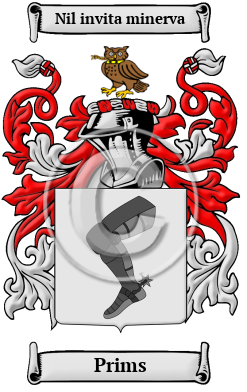
The motto was originally a war cry or slogan. Mottoes first began to be shown with arms in the 14th and 15th centuries, but were not in general use until the 17th century. Thus the oldest coats of arms generally do not include a motto. Mottoes seldom form part of the grant of arms: Under most heraldic authorities, a motto is an optional component of the coat of arms, and can be added to or changed at will; many families have chosen not to display a motto.
Motto: Nil invita minerva
Motto Translation: Nothing contrary to one’s genius.
- Harrison, Henry, Surnames of the United Kingdom: A Concise Etymological Dictionary Baltimore: Geneological Publishing Company, 2013. Print
- Smith, Eldson Coles, New Dictionary of American Family Names New York: Harper & Row, 1956. Print
- Reaney, P.H and R.M. Wilson, A Dictionary of English Surnames. London: Routledge, 1991. Print. (ISBN 0-415-05737-X)
- Lower, Mark Anthony, Patronymica Britannica, A Dictionary of Family Names of the United Kingdom. London: John Russel Smith, 1860. Print.
 |