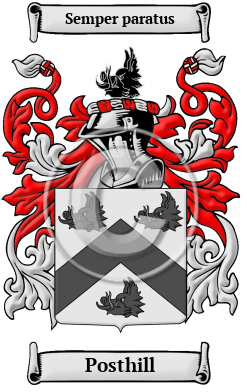
| ![Show Contents]() Posthill History, Family Crest & Coats of Arms Posthill History, Family Crest & Coats of Arms
- Origins Available:
Scotland
Etymology of PosthillWhat does the name Posthill mean? The Posthill surname is thought to derive from a place name, most likely from Postlewaite in the Parish of Millom, Cumberland. The place name comes from and Old English personal name Possel or Postel, combined with "thwaite," which means "a clearing." Early Origins of the Posthill familyThe surname Posthill was first found in Cumberland, where they held a family seat as Lords of the Manor. The family appear from ancient documents to have held lands in various parts of Cumberland from an early period. The original name came from Possel or Postel's clearing, a thwaite being a clearing. In time, the 'thwaite' was corrupted to 'white' and some of the family name still prefer this spelling. Early History of the Posthill familyThis web page shows only a small excerpt of our Posthill research. Another 100 words (7 lines of text) covering the years 1650, 1713, 1780 and 1809 are included under the topic Early Posthill History in all our PDF Extended History products and printed products wherever possible. Posthill Spelling VariationsSpelling variations of this family name include: Postlethwaite, Postelthwaite, Postel, Postell, Postels, Postells, Postill, Posselthwaite, Postlewhite, Postlethwait, Poslethwaite, Postlewaite, Poslethwait, Postillthwaite, Postilthwaite and many more. Early Notables of the Posthill familyAnother 36 words (3 lines of text) are included under the topic Early Posthill Notables in all our PDF Extended History products and printed products wherever possible.
| Posthill migration to the United States | + |
Posthill Settlers in United States in the 19th Century- P Posthill, aged 27, who landed in New Orleans, La in 1832 1
- Gabriel Posthill, aged 12, who arrived in New Orleans, La in 1839 1
The motto was originally a war cry or slogan. Mottoes first began to be shown with arms in the 14th and 15th centuries, but were not in general use until the 17th century. Thus the oldest coats of arms generally do not include a motto. Mottoes seldom form part of the grant of arms: Under most heraldic authorities, a motto is an optional component of the coat of arms, and can be added to or changed at will; many families have chosen not to display a motto.
Motto: Semper paratus
Motto Translation: Always prepared.
- Filby, P. William, Meyer, Mary K., Passenger and immigration lists index : a guide to published arrival records of about 500,000 passengers who came to the United States and Canada in the seventeenth, eighteenth, and nineteenth centuries. 1982-1985 Cumulated Supplements in Four Volumes Detroit, Mich. : Gale Research Co., 1985, Print (ISBN 0-8103-1795-8)
 |