
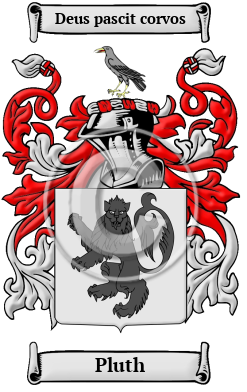
Show ContentsPluth History, Family Crest & Coats of Arms

Etymology of Pluth

What does the name Pluth mean?

This old, proud name is a patronymic name created from the Welsh personal name Rhydderc, Riderch, or Roderick, all of which mean "reddish-brown." The surname Pluth features the distinctive Welsh patronymic prefix "ap-," which means "son of." The original form of the name was ap-Rhydderc, or ap-Riderch, but the prefix has been assimilated into the surname over the course of time.

Early Origins of the Pluth family

The surname Pluth was first found in Carmarthenshire (Welsh: Sir Gaerfyrddin), located in Southwest Wales, one of thirteen historic counties and presently one of the principal area in Wales, where they held a family seat from very ancient times, some say well before the Norman Conquest and the arrival of Duke William at Hastings in 1066 A.D.

Early History of the Pluth family

This web page shows only a small excerpt of our Pluth research. Another 60 words (4 lines of text) covering the year 1688 is included under the topic Early Pluth History in all our PDF Extended History products and printed products wherever possible.

Pluth Spelling Variations

Although there are comparatively few Welsh surnames, they have a great many spelling variations. Variations of Welsh names began almost immediately after their acceptance within Welsh society. In the Middle Ages, it was up to priests and the few other people that recorded names in official documents to decide how to spell the names that they heard. Variations that occurred because of improper recording increased dramatically as the names were later transliterated into English. The Brythonic Celtic language of Wales, known by natives as Cymraeg, featured many highly inflected sounds that could not be properly captured by the English language. Spelling variations were, however, also carried out according to an individual's design: a branch loyalty within the family, a religious adherence, or even patriotic affiliations were all indicated by the particular variation of one's name. The spelling variations of the name Pluth have included Protheroe, Prytherch, Prothers, Rhydderch and others.

Early Notables of the Pluth family

More information is included under the topic Early Pluth Notables in all our PDF Extended History products and printed products wherever possible.

Migration of the Pluth family

Many people from Wales joined the general migration to North America in the 19th and 20th centuries, searching for land, work, and freedom. Like the many other immigrants from the British Isles, they made a significant contribution to the development of Canada and the United States. The Welsh and their descendents added a rich cultural tradition to the newly developed towns, cities, and villages. An investigation of the immigration and passenger lists has revealed a number of people bearing the name Pluth: Elizabeth Protheroe who settled in Virginia in 1663; Thomas Prothers settled in Barbados in 1679 with his servants; Sylvanus Prytherow settled in New England in 1762..


The Pluth Motto +

The motto was originally a war cry or slogan. Mottoes first began to be shown with arms in the 14th and 15th centuries, but were not in general use until the 17th century. Thus the oldest coats of arms generally do not include a motto. Mottoes seldom form part of the grant of arms: Under most heraldic authorities, a motto is an optional component of the coat of arms, and can be added to or changed at will; many families have chosen not to display a motto.

Motto: Deus pascit corvos
Motto Translation: God feeds the ravens.


Houseofnames.com on Facebook