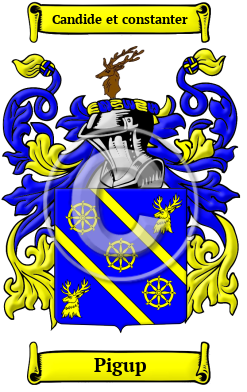
| ![Show Contents]() Pigup History, Family Crest & Coats of Arms Pigup History, Family Crest & Coats of Arms
- Origins Available:
England
Etymology of PigupWhat does the name Pigup mean? The name Pigup is of Anglo-Saxon origin and came from when the family lived in Pickup or Pickup Bank in Lancashire. This place-name was originally derived from the Old English word pic-copp which referred to those individuals who lived on a hill with a sharp peak. 1 Early Origins of the Pigup familyThe surname Pigup was first found in Lancashire where they are "from a township and village in the parish of Walley, now styled Yatecum-Pickup Bank." 2 "The Pickups derive their name from Pickup Bank, or Piccopbanke, a, village in Whalley parish. In the 16th century the Piccopps lived at Lower Darwen, a family with which the Piccops of Eccleshill in the succeeding century were connected: from early in the 17th century the Pickops have held their own estate on the borders of Livesey and Tockholes." 3 The Wills at Chester had the following entries: Roger Piccop, of Over Whiteley, 1584; James Piccop, of Nether Darwen, 1592; John Piccope, of Rawtenstall, 1623; John Piccopp, of Eccleshill; Robert Holden, of Picope Bank, 1595; John Tattersall, of Piccope, 1581; and Robert Tattersall, of Piccope, yeoman, 1587. 2 Early History of the Pigup familyThis web page shows only a small excerpt of our Pigup research. Another 89 words (6 lines of text) are included under the topic Early Pigup History in all our PDF Extended History products and printed products wherever possible. Pigup Spelling VariationsIt is only in the last few hundred years that the English language has been standardized. For that reason, early Anglo-Saxon surnames like Pigup are characterized by many spelling variations. As the English language changed and incorporated elements of other European languages, even literate people changed the spelling of their names. Scribes and monks in the Middle Ages spelled names they sounded, so it is common to find several variations that refer to a single person. The variations of the name Pigup include: Pickup, Pickupp, Pickopp, Pickop, Picup and others. Early Notables of the Pigup familyMore information is included under the topic Early Pigup Notables in all our PDF Extended History products and printed products wherever possible. Migration of the Pigup familyMany English families tired of political and religious strife left Britain for the new colonies in North America. Although the trip itself offered no relief - conditions on the ships were extremely cramped, and many travelers arrived diseased, starving, and destitute - these immigrants believed the opportunities that awaited them were worth the risks. Once in the colonies, many of the families did indeed prosper and, in turn, made significant contributions to the culture and economies of the growing colonies. An inquiry into the early roots of North American families has revealed a number of immigrants bearing the name Pigup or a variant listed above: James, Joseph and William Pickup, who all settled in Philadelphia between 1853 and 1868.
The motto was originally a war cry or slogan. Mottoes first began to be shown with arms in the 14th and 15th centuries, but were not in general use until the 17th century. Thus the oldest coats of arms generally do not include a motto. Mottoes seldom form part of the grant of arms: Under most heraldic authorities, a motto is an optional component of the coat of arms, and can be added to or changed at will; many families have chosen not to display a motto.
Motto: Candide et constanter
Motto Translation: Candid and steady.
- Mills, A.D., Dictionary of English Place-Names. Oxford: Oxford University Press, 1991. Print. (ISBN 0-19-869156-4)
- Bardsley, C.W, A Dictionary of English and Welsh Surnames: With Special American Instances. Wiltshire: Heraldry Today, 1901. Print. (ISBN 0-900455-44-6)
- Guppy, Henry Brougham, Homes of Family Names in Great Britain. 1890. Print.
 |