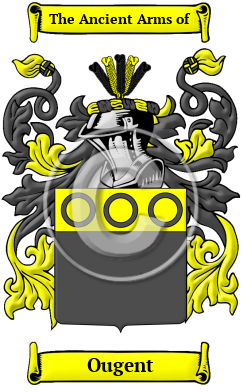
There are a multitude of ancient meanings and variations associated with the Irish surnames that are now common throughout the modern world. The original Gaelic form of the name Ougent is Ó hÓgáin, meaning a descendant of Ógán’, a personal name derived from the Irish Gaelic word "og," which means "young."
Loading...
Early Origins of the Ougent family
The surname Ougent was first found in County Tipperary (Irish: Thiobraid Árann), established in the 13th century in South-central Ireland, in the province of Munster where one of the first records of the name was Mathew O'Hogan a native of Ballyhogan and Dean of Killaloe who died in 1281. He held the position from 1267 until his death when he was interred in the Dominican convent at Limerick. Thus began the long line of O'Hogans who held lofty positions in the church. His successor was Maurice O'Hogan, who was consecrated in 1282 and governed his see for seventeen years until his death. Thomas O'Hogan, canon of Killaloe was consecrated bishop of the see in 1343 until his death in 1354.
Early History of the Ougent family
This web page shows only a small excerpt of our Ougent research. Another 67 words (5 lines of text) are included under the topic Early Ougent History in all our PDF Extended History products and printed products wherever possible.
Ougent Spelling Variations
One explanation for the many variations is that scribes and church officials frequently spelled the name as it sounded: an imprecise method at best. Understandably then, various spellings of the surname Ougent were found in the many archives researched. These included Hogan, O'Hogan, Hogen, Hoggin and others.
Early Notables of the Ougent family
More information is included under the topic Early Ougent Notables in all our PDF Extended History products and printed products wherever possible.
Loading...
Loading...
Loading...
Loading...
Migration of the Ougent family
Suffering from poverty and racial discrimination, thousands of Irish families left the island in the 19th century for North America aboard cramped passenger ships. The early migrants became settlers of small tracts of land, and those that came later were often employed in the new cities or transitional work camps. The largest influx of Irish settlers occurred with Great Potato Famine during the late 1840s. Although the immigrants from this period were often maligned when they arrived in the United States, they provided the cheap labor that was necessary for the development of that country as an industrial power. Early immigration and passenger lists have revealed many immigrants bearing the name Ougent: Sebastian Hogan settled in New England in 1764; Daniel, David, Denis, Edward, James, John, Michael, Patrick, Robert, Thomas and William Hogan, all arrived in Pennsylvania between 1840 and 1870..