
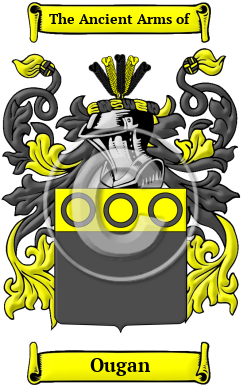
Show ContentsOugan History, Family Crest & Coats of Arms

Etymology of Ougan

What does the name Ougan mean?

There are a multitude of ancient meanings and variations associated with the Irish surnames that are now common throughout the modern world. The original Gaelic form of the name Ougan is Ó hÓgáin, meaning a descendant of Ógán’, a personal name derived from the Irish Gaelic word "og," which means "young."

Early Origins of the Ougan family

The surname Ougan was first found in County Tipperary (Irish: Thiobraid Árann), established in the 13th century in South-central Ireland, in the province of Munster where one of the first records of the name was Mathew O'Hogan a native of Ballyhogan and Dean of Killaloe who died in 1281. He held the position from 1267 until his death when he was interred in the Dominican convent at Limerick. Thus began the long line of O'Hogans who held lofty positions in the church. His successor was Maurice O'Hogan, who was consecrated in 1282 and governed his see for seventeen years until his death. Thomas O'Hogan, canon of Killaloe was consecrated bishop of the see in 1343 until his death in 1354.

Early History of the Ougan family

This web page shows only a small excerpt of our Ougan research. Another 67 words (5 lines of text) are included under the topic Early Ougan History in all our PDF Extended History products and printed products wherever possible.

Ougan Spelling Variations

Many variations of the name Ougan were found in archives from the Middle Ages. These variations can be somewhat explained by the challenge of translation of Gaelic names into English. Hence, the spelling and language in which the people's names were recorded was often up to the individual scribe. Variations of the name Ougan found include Hogan, O'Hogan, Hogen, Hoggin and others.

Early Notables of the Ougan family

More information is included under the topic Early Ougan Notables in all our PDF Extended History products and printed products wherever possible.


Ougan migration to the United States +

Irish families began leaving their homeland for North America in the late 18th century. These families were usually modestly well off, but they were looking forward to owning and working on a sizable tract of land of their own. This pattern of emigration continued until the 1840s when the Great Potato Famine sparked a major exodus of destitute and desperate Irish people. These people were not leaving for a grant of land in North America because by this time the East Coast had reached its saturation point and free land was scarce. They were merely looking to escape the disease, starvation, and hopelessness that Ireland had fallen into. Although these unfortunate immigrants did not receive a warm welcome by the established populations in the United States and what would become Canada, they were absolutely critical to the rapid development that these two nations enjoyed. They would help populate the western lands and provide the cheap labor required for a rapid industrialization. An examination of passenger and immigration lists has revealed many early bearers of the name Ougan or one of its variants:

Ougan Settlers in United States in the 18th Century
  • James Ougan, who landed in South Carolina in 1755 1
  • Line Ougan, who arrived in South Carolina in 1755 1
  • Peter Ougan, who landed in South Carolina in 1755 1
  • William Ougan, aged 30, who arrived in Pennsylvania in 1775 1


  1. Filby, P. William, Meyer, Mary K., Passenger and immigration lists index : a guide to published arrival records of about 500,000 passengers who came to the United States and Canada in the seventeenth, eighteenth, and nineteenth centuries. 1982-1985 Cumulated Supplements in Four Volumes Detroit, Mich. : Gale Research Co., 1985, Print (ISBN 0-8103-1795-8)


Houseofnames.com on Facebook