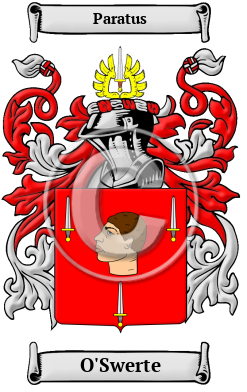
The name O'Swerte most often comes from the Irish name Ó Suaird, which, when Anglicized in a Fiant of 1562, becomes O'Sword. In County Down, in the early 17th century, the name was recorded in the Ulster Inquisitions as Swords, Swoordes, and Sourdes.
In County Kildare the name Swords was often a mistranslation of the Irish name Ó Claimhin, which was mistakenly equated with the Irish word "claidheamh" meaning "sword." Thus, the name Clavin is a synonym for Swords. In County Mayo Claveen is also a synonym. In the 14th century the name de Swerdes, derived from the village, appeared in several places in Ireland.
Loading...
Early Origins of the O'Swerte family
The surname O'Swerte was first found in Counties Offaly, Leix, and Kildare, where in 1016, the successor of St. Brigid, abbess of Kildare, was named Ó Suairt according to the Four Masters. (O'Hart)
Early History of the O'Swerte family
This web page shows only a small excerpt of our O'Swerte research. More information is included under the topic Early O'Swerte History in all our PDF Extended History products and printed products wherever possible.
O'Swerte Spelling Variations
Spelling variations of this family name include: Swords, O'Sword, O'Swerte, Swoordes, Sourdes, Swerdes, Clavin and many more.
Early Notables of the O'Swerte family
More information is included under the topic Early O'Swerte Notables in all our PDF Extended History products and printed products wherever possible.
Loading...
Loading...
Loading...
Loading...
Migration of the O'Swerte family
Some of the first settlers of this family name or some of its variants were: Richard Swords, who was a bonded emigrant from Ireland in 1742; Thomas Swords, who was naturalized in Pennsylvania in 1795; Edward Swords, who was naturalized in Philadelphia in 1816.
The motto was originally a war cry or slogan. Mottoes first began to be shown with arms in the 14th and 15th centuries, but were not in general use until the 17th century. Thus the oldest coats of arms generally do not include a motto. Mottoes seldom form part of the grant of arms: Under most heraldic authorities, a motto is an optional component of the coat of arms, and can be added to or changed at will; many families have chosen not to display a motto.
Motto: Paratus Motto Translation: Paratus.
Remove Item
WARNING!
Removing this item from your shopping cart will remove your associated sale items.
Are you sure you want to delete this item from your shopping cart?