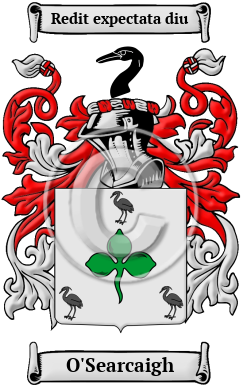
Hundreds of years ago, the Gaelic name used by the O'Searcaigh family in Ireland was Ó Searcaigh, which is derived from the word "searcach," which means "loving."
Loading...
Early Origins of the O'Searcaigh family
The surname O'Searcaigh was first found in Tyrone (Irish:Tír Eoghain), the ancient territory of the O'Neills, now in the Province of Ulster, central Northern Ireland, where they were established in ancient times.
Early History of the O'Searcaigh family
This web page shows only a small excerpt of our O'Searcaigh research. Another 116 words (8 lines of text) covering the year 1578 is included under the topic Early O'Searcaigh History in all our PDF Extended History products and printed products wherever possible.
O'Searcaigh Spelling Variations
Within the archives researched, many different spelling variations of the surname O'Searcaigh were found. These included One reason for the many variations is that scribes and church officials often spelled an individual's name as it sounded. This imprecise method often led to many versions. Sharkey, O'Sharkey, Sharket, O'Serky, O'Sherkott, Sherkott, O'Sergoid and many more.
Early Notables of the O'Searcaigh family
More information is included under the topic Early O'Searcaigh Notables in all our PDF Extended History products and printed products wherever possible.
Loading...
Loading...
Loading...
Loading...
Migration of the O'Searcaigh family
The 19th century saw a great wave of Irish families leaving Ireland for the distant shores of North America and Australia. These families often left their homeland hungry, penniless, and destitute due to the policies of England. Those Irish immigrants that survived the long sea passage initially settled on the eastern seaboard of the continent. Some, however, moved north to a then infant Canada as United Empire Loyalists after ironically serving with the English in the American War of Independence. Others that remained in America later joined the westward migration in search of land. The greatest influx of Irish immigrants, though, came to North America during the Great Potato Famine of the late 1840s. Thousands left Ireland at this time for North America, and those who arrived were immediately put to work building railroads, coal mines, bridges, and canals. In fact, the foundations of today's powerful nations of the United States and Canada were to a larger degree built by the Irish. Archival documents indicate that members of the O'Searcaigh family relocated to North American shores quite early: Peter Sharkey, who sailed to Virginia in 1649; George Sharkey was living in Maryland at the end of the 18th century, Barnard Sharkey sailed to Philadelphia in 1811.
The motto was originally a war cry or slogan. Mottoes first began to be shown with arms in the 14th and 15th centuries, but were not in general use until the 17th century. Thus the oldest coats of arms generally do not include a motto. Mottoes seldom form part of the grant of arms: Under most heraldic authorities, a motto is an optional component of the coat of arms, and can be added to or changed at will; many families have chosen not to display a motto.
Motto: Redit expectata diu Motto Translation: The expected returns for a long time
Remove Item
WARNING!
Removing this item from your shopping cart will remove your associated sale items.
Are you sure you want to delete this item from your shopping cart?
HouseofNames E-Newsletter Sign Up
On Demand Gifts | Digital Products Available 24/7
A Gift for Everyone on your List is a Click Away - Shop Now