| ![Show Contents]() O'Rook History, Family Crest & Coats of Arms O'Rook History, Family Crest & Coats of Arms
- Origins Available:
Ireland
Etymology of O'RookWhat does the name O'Rook mean? The Irish name O'Rook has a long Gaelic heritage to its credit. The original Gaelic form of the name O'Rook is Ó Ruairc, which means descendant of Ruairc and; Ruairc is a personal name imported by Norse settlers. Early Origins of the O'Rook familyThe surname O'Rook was first found in counties Cavan and Leitrim (Irish: Liatroim) anciently the western half of the kingdom of Breifne, located in Northeastern Ireland, in Leinster province. Of note was Tiernan O'Rourke (d. 1172), King of Breifne, called in Irish Tighearnan Ua Ruairc; he was head of the clans known as the Ui Briuin, or as the race of Aedh finn, and ruled Breifne. He first appears in the chronicles in 1124, and at that date had a son, Gillabroide, who was slain in battle with the Connaughtmen. O'Rourke had a considerable body of cavalry, and was defeated by a similar force under Conchobhar MacLochlainn at Ardee, co. Louth, in 1128. In 1130 he defeated and slew Diarmait O'Maelsechlainn, king of Meath, at Slieve Guaire, co. Cavan, and in the following year he ravaged Cuailgne and Omeath, then districts of Ulster, now in the co. Louth. 1 Nineteen other chiefs or tanists named Tiernan O'Rourke occur in the Irish chronicles, of whom the most important was chief of the race of Aedh finn and of Breifne, married Aine, daughter of Tadhg MacDonnchaidh, and died in 1467. 1 Early History of the O'Rook familyThis web page shows only a small excerpt of our O'Rook research. Another 128 words (9 lines of text) covering the years 1046, 1172, 1532, 1536, 1562, 1564, 1566, 1576, 1578, 1591 and 1771 are included under the topic Early O'Rook History in all our PDF Extended History products and printed products wherever possible. O'Rook Spelling VariationsMany spelling variations of the surname O'Rook can be found in the archives. One reason for these variations is that ancient scribes and church officials recorded names as they were pronounced, often resulting in a single person being recorded under several different spellings. The different spellings that were found include O'Rourke, O'Rorke, O'Rork, O'Rourk, O'Roark, Rourke, Rorke, Rourk, Roarke and many more. Early Notables of the O'Rook familySir Brian-Na-Murtha O'Rourke (d. 1591), Irish chieftain, a younger son of Brian Ballagh O'Rourke. "His grandfather, Owen O'Rourke, who was ‘chief of his name,’ was slain at Dromore in 1532, his son Brian Ballagh, ‘the speckled or freckled,’ being declared the O'Rourke in 1536. Brian Ballagh spent a life of constant fighting against his kinsmen and the English, and died in consequence of a fall in 1562; he ‘had the best collection of poems, and of all his tribe had bestowed the greatest number of presents for poetical eulogies;’ he was ‘senior of Sil-Feargna and of the race of Aedh-Finn’ (i.e...
Another 258 words (18 lines of text) are included under the topic Early O'Rook Notables in all our PDF Extended History products and printed products wherever possible. Migration of the O'Rook familyA great mass of Ireland's native population left the island in the 19th century, seeking relief from various forms of social, religious, and economic discrimination. This Irish exodus was primarily to North America. If the migrants survived the long ocean journey, many unfortunately would find more discrimination in the colonies of British North America and the fledgling United States of America. These newly arrived Irish were, however, wanted as a cheap source of labor for the many large agricultural and industrial projects that were essential to the development of what would become two of the wealthiest nations in the western world. Early immigration and passenger lists indicate many people bearing the O'Rook name: Henry Roark who settled in Pennsylvania in 1773; Owen Roarke settled in Philadelphia in 1851; Anne Rourk settled with her husband in Maine in 1822; Bernard, Charles, Daniel, Felix, John, Michael, Patrick, Richard and William Rourke all arrived in Philadelphia between 1840 and 1860.
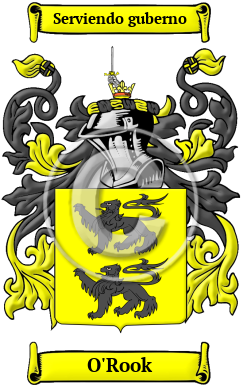
The motto was originally a war cry or slogan. Mottoes first began to be shown with arms in the 14th and 15th centuries, but were not in general use until the 17th century. Thus the oldest coats of arms generally do not include a motto. Mottoes seldom form part of the grant of arms: Under most heraldic authorities, a motto is an optional component of the coat of arms, and can be added to or changed at will; many families have chosen not to display a motto.
Motto: Serviendo guberno
Motto Translation: I govern by serving.
- Smith, George (ed), Dictionary of National Biography. London: Smith, Elder & Co., 1885-1900. Print
 |