| ![Show Contents]() O'Key History, Family Crest & Coats of Arms O'Key History, Family Crest & Coats of Arms
- Origins Available:
England
Etymology of O'KeyWhat does the name O'Key mean? The ancestry of the name O'Key dates from the ancient Anglo-Saxon culture of Britain. It comes from when the family lived near a notable oak tree or near a group of oaks. The surname O'Key is derived from the Old English word ac, which means oak. The surname O'Key belongs to the class of topographic surnames, which were given to people who resided near physical features such as hills, streams, churches, or types of trees. Early Origins of the O'Key familyThe surname O'Key was first found in Somerset where Oake is a village and civil parish that dates back to before the Norman Copnquest when it was listed as Acon in 897. The place was listed as Acha in the Domesday Book 1 and literally means "place at the oak trees" from the Old Englisk word "ac" 2 Early History of the O'Key familyThis web page shows only a small excerpt of our O'Key research. Another 69 words (5 lines of text) covering the years 1606, 1631, 1640, 1644, 1645, 1662, 1675, 1680, 1681 and 1719 are included under the topic Early O'Key History in all our PDF Extended History products and printed products wherever possible. O'Key Spelling VariationsSpelling variations in names were a common occurrence before English spelling was standardized a few hundred years ago. In the Middle Ages, even the literate spelled their names differently as the English language incorporated elements of French, Latin, and other European languages. Many variations of the name O'Key have been found, including Oak, Oake, Oakes, Oke, Okes and others. Early Notables of the O'Key family- John Okey (1606-1662), an English soldier, Member of Parliament, one of the regicides of King Charles
| O'Key migration to the United States | + |
Families began migrating abroad in enormous numbers because of the political and religious discontent in England. Often faced with persecution and starvation in England, the possibilities of the New World attracted many English people. Although the ocean trips took many lives, those who did get to North America were instrumental in building the necessary groundwork for what would become for new powerful nations. Some of the first immigrants to cross the Atlantic and come to North America bore the name O'Key, or a variant listed above:
O'Key Settlers in United States in the 17th Century- William Okey, who arrived in Virginia in 1664 4
- John Okey, who landed in Maryland in 1666 4
O'Key Settlers in United States in the 19th Century- Mr. Edward Okey, aged 25, British farmer who arrived in New York aboard the ship "Rochester" on 20th May 1841
| O'Key migration to Australia | + |
Emigration to Australia included the First Fleet and Third Fleet of convicts, tradespeople and early settlers. Early immigrants include: First Fleet Third Fleet - Mr. William Okey, (b. 1769), aged 18, English labourer convicted in Gloucester, Gloucestershire on 24th March 1784, sentenced for 7 years for theft, transported aboard the ship "Alexander" leaving in 1787 arriving in New South Wales, Australia in 1788 4
| O'Key migration to New Zealand | + |
Emigration to New Zealand followed in the footsteps of the European explorers, such as Captain Cook (1769-70): first came sealers, whalers, missionaries, and traders. By 1838, the British New Zealand Company had begun buying land from the Maori tribes, and selling it to settlers, and, after the Treaty of Waitangi in 1840, many British families set out on the arduous six month journey from Britain to Aotearoa to start a new life. Early immigrants include: O'Key Settlers in New Zealand in the 19th Century- George Richard Okey, aged 22, who arrived in Wellington, New Zealand aboard the ship "Ann Wilson" in 1857
| Contemporary Notables of the name O'Key (post 1700) | + |
- Mark Okey, American former politician, Democratic member of the Ohio House of Representatives (2007-2010)
- Frank Okey (b. 1919), born Francis Anthony Okolowicz, American tennis and squash champion who won 85 tennis tournament wins
- John Clark "Jack" Okey (1889-1963), American two-time Academy Award nominated art director
- John Waterman Okey (1827-1885), American jurist, Ohio Supreme Court Justice (1878-1885)
- Shannon Okey (b. 1975), American writer and knit designer
- William Okey, American politician, Delegate to Ohio State Constitutional Convention from Monroe County, 1873 5
- Steven Okey, American Democratic Party politician, Delegate to Democratic National Convention from Ohio, 2004 6
- Thomas Okey (1852-1935), Expert on basket weaving, Italian translator, and a writer on art and the topography of architecture and art works in Italy and France, first professor in Cambridge University under the Serena Professor of Italian (1919)
- Henry James Hobbs Okey (1857-1918), New Zealand politician, Member of Parliament for Taranaki (1907-1918)
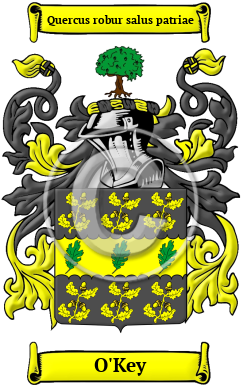
The motto was originally a war cry or slogan. Mottoes first began to be shown with arms in the 14th and 15th centuries, but were not in general use until the 17th century. Thus the oldest coats of arms generally do not include a motto. Mottoes seldom form part of the grant of arms: Under most heraldic authorities, a motto is an optional component of the coat of arms, and can be added to or changed at will; many families have chosen not to display a motto.
Motto: Quercus robur salus patriae
Motto Translation: The strength of the oak is the safety of our country.
- Williams, Dr Ann. And G.H. Martin, Eds., Domesday Book A Complete Translation. London: Penguin, 1992. Print. (ISBN 0-141-00523-8)
- Mills, A.D., Dictionary of English Place-Names. Oxford: Oxford University Press, 1991. Print. (ISBN 0-19-869156-4)
- Convict Records of Australia. Retrieved 4th February 2021 from https://convictrecords.com.au/ships
- Filby, P. William, Meyer, Mary K., Passenger and immigration lists index : a guide to published arrival records of about 500,000 passengers who came to the United States and Canada in the seventeenth, eighteenth, and nineteenth centuries. 1982-1985 Cumulated Supplements in Four Volumes Detroit, Mich. : Gale Research Co., 1985, Print (ISBN 0-8103-1795-8)
- The Political Graveyard: Alphabetical Name Index. (Retrieved 2015, December 11) . Retrieved from http://politicalgraveyard.com/alpha/index.html
 |