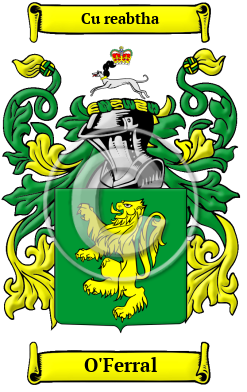
| ![Show Contents]() O'Ferral History, Family Crest & Coats of Arms O'Ferral History, Family Crest & Coats of Arms
- Origins Available:
Ireland
Etymology of O'FerralWhat does the name O'Ferral mean? The O'Ferral surname comes from the Irish Gaelic name Ó Fearghail, which means "a valiant warrior." (O'Hart) Early Origins of the O'Ferral familyThe surname O'Ferral was first found in Leinster, where they were found mainly in County Longford. Feargal, Prince of Annaly appears number 105 on the "Line of Ir" descendants. Ir was the fifth son of Milesius of Spain. This Feargal was slain fighting on the aide of Brian Boru at the Battle of Clontarf in 1014. However, some writers doubt this claim. From this progenitor, rose O'Farrell Ban, O'Farrell of Rathline, O'Farrell, the Chiefs of Clanhugh, O'Farrell of Mugh Treagha, O'Farrell of Kenagh and O'Farrell, Chiefs of Clanawley. (O'Hart) Early History of the O'Ferral familyThis web page shows only a small excerpt of our O'Ferral research. Another 185 words (13 lines of text) covering the years 1235, 1248 and 1659 are included under the topic Early O'Ferral History in all our PDF Extended History products and printed products wherever possible. O'Ferral Spelling VariationsNumerous spelling variations of the surname O'Ferral exist. A partial explanation for these variants is that ancient scribes and church officials recorded names as they were pronounced, often resulting in a single person being recorded under several different spellings. Different spellings that were found include Ferrell, Farrell, O'Ferrall, O'Farrell, Farrelly, Fraleigh, Frawley, Frahill and many more. Early Notables of the O'Ferral familyJean François Ferrel, a musician in Paris about the middle of the 17th century, wrote a small pamphlet 'A savoir que les maistres de dance, qui sont de vrays maistres larrons à l'endroit des violons de France, n'ont pas royale commission...
Another 41 words (3 lines of text) are included under the topic Early O'Ferral Notables in all our PDF Extended History products and printed products wherever possible. Migration of the O'Ferral familyIrish families began to immigrate to British North America and the United States in the 18th century, but the greatest influx of Irish immigrants came during the Great Potato Famine of the late 1840s. The earlier settlers came to North America after a great deal of consideration and by paying relatively high fees for their passage. These settlers were primarily drawn by the promise of land. Those later settlers that came during the 1840's were trying to escape the conditions of poverty, starvation, disease, and death that had stricken Ireland. Due to the enormity of their numbers and the late date of their arrival, these immigrants primarily became hired laborers instead of homesteading settlers like their predecessors. An exhaustive search of immigration and passenger lists has revealed many Irish immigrants North America bearing the name O'Ferral: Bridget Ferrell who settled in Barbados in 1680; Katherine Ferrell settled in Virginia in 1649; Alexander Farrell settled in Virginia in 1656; Atkinson, Barney, Bernard, Charles, Christopher, Daniel, Dennis, Edward, Eiden, Francis, George, Hamilton, Hugh, James, John, Laurence, Lawrence, Luke, Martin, Michael, Patrick, Peter, Richard, Robert, Thomas and William Farrell, all settled in Philadelphia between 1840 and 1860. Martin and Michael Frawly arrived in Philadelphia in 1868 and 1874.
The motto was originally a war cry or slogan. Mottoes first began to be shown with arms in the 14th and 15th centuries, but were not in general use until the 17th century. Thus the oldest coats of arms generally do not include a motto. Mottoes seldom form part of the grant of arms: Under most heraldic authorities, a motto is an optional component of the coat of arms, and can be added to or changed at will; many families have chosen not to display a motto.
Motto: Cu reabtha
Motto Translation: The rampaging dog.
 |