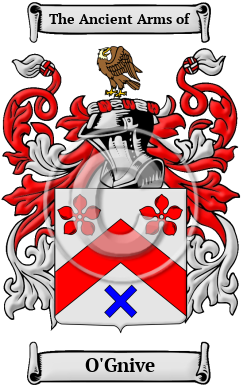
The Irish name O'Gnive comes from the Gaelic "ó Gnimh." The name was written O'Gnive, O'Gnimh, O'Gnyw in English, which, through pronunciation based on spellings became O'Gnew and eventually Agnew.
Loading...
Early Origins of the O'Gnive family
The surname O'Gnive was first found in Antrim (Irish: Aontroim) located in the province of Ulster in present day Northern Ireland, where they arrived as the families of Scottish mercenary soldiers in early times. Their lands were in Larne and also in northern Antrim.
Early History of the O'Gnive family
This web page shows only a small excerpt of our O'Gnive research. Another 211 words (15 lines of text) covering the years 1200, 1314, 1580, 1640, 1659 and 1665 are included under the topic Early O'Gnive History in all our PDF Extended History products and printed products wherever possible.
O'Gnive Spelling Variations
Many spelling variations of the surname O'Gnive can be found in the archives. One reason for these variations is that ancient scribes and church officials recorded names as they were pronounced, often resulting in a single person being recorded under several different spellings. The different spellings that were found include Agnew, O'Gnive, O'Gnew, O'Gneeve and others.
Early Notables of the O'Gnive family
More information is included under the topic Early O'Gnive Notables in all our PDF Extended History products and printed products wherever possible.
Loading...
Loading...
Loading...
Loading...
Migration of the O'Gnive family
In the 19th century, thousands of Irish left their English-occupied homeland for North America. Like most new world settlers, the Irish initially settled on the eastern shores of the continent but began to move westward with the promise of owning land. The height of this Irish migration came during the Great Potato Famine of the late 1840s. With apparently nothing to lose, Irish people left on ships bound for North America and Australia. Unfortunately a great many of these passengers lost their lives - the only thing many had left - to disease, starvation, and accidents during the long and dangerous journey. Those who did safely arrive in "the land of opportunities" were often used for the hard labor of building railroads, coal mines, bridges, and canals. The Irish were critical to the quick development of the infrastructure of the United States and Canada. Passenger and immigration lists indicate that members of the O'Gnive family came to North America quite early: Andrew Agnew, who arrived in New England in 1718; Deckey Agnew, who arrived at New York, NY in 1815; Catharine Agnew, who came to New York, NY in 1824.