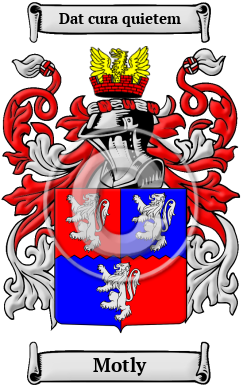
| ![Show Contents]() Motly History, Family Crest & Coats of Arms Motly History, Family Crest & Coats of Arms
Etymology of MotlyWhat does the name Motly mean? The Motly surname comes from when the Motly family lived in the settlement of Medlicott in the English border county of Shropshire. The surname Motly belongs to the category of habitation names, which are derived from pre-existing names for towns, villages, parishes, or farmsteads. Early Origins of the Motly familyThe surname Motly was first found in Shropshire, at Medlicott, a parish in Wentnor. It is generally believed that the oldest record of the family was Llewelyn de Modlicott who resided here c. 1180. He was son of Sir Roger de Meldron (died c. 1200.) By the Hundredorum Rolls of 1273, some of the family were found in Devonshire where Richard de Middlecote was listed as holding lands at that time. 1 "The ancient Shropshire family of Medlicott, which took its name from a manor, flourished in the 13th century. The Medlycott family of Ven House, Milborne Port, Somerset, originally came from Shropshire." 2 Early History of the Motly familyThis web page shows only a small excerpt of our Motly research. Another 154 words (11 lines of text) covering the years 1586, 1593 and 1625 are included under the topic Early Motly History in all our PDF Extended History products and printed products wherever possible. Motly Spelling VariationsCompared to other ancient cultures found in the British Isles, the number of Welsh surnames are relatively few, but there are an inordinately large number of spelling variations. These spelling variations began almost as soon as surname usage became common. As a result, people could not specify how to spell their own names leaving the specific recording up to the individual scribe or priest. Those recorders would then spell the names as they heard them, causing many different variations. Later, many Welsh names were recorded in English. This transliteration process was extremely imprecise since the Brythonic Celtic language of the Welsh used many sounds the English language was not accustomed to. Finally, some variations occurred by the individual's design: a branch loyalty within a family, a religious adherence, or even patriotic affiliations were indicated by spelling variations of one's name. The Motly name over the years has been spelled Medlicot, Medlicott, Medlycot, Medlycott, Medlicote, Medleycot, Medleycott, Medleycote, Modlicot, Modlicote and many more. Early Notables of the Motly familyMore information is included under the topic Early Motly Notables in all our PDF Extended History products and printed products wherever possible. Migration of the Motly family to IrelandSome of the Motly family moved to Ireland, but this topic is not covered in this excerpt. More information about their life in Ireland is included in all our PDF Extended History products and printed products wherever possible.
| Motly migration to the United States | + |
Many Welsh joined the great migrations to North America in the late 1800s and early 1900s. Like their Scottish and Irish neighbors, many Welsh families left their homeland hoping to find hope and prosperity in a land that the English did not exercise a tight rule over. Those Welsh immigrants that successfully traveled to North America went on to make significant contributions to the rapid development of both Canada and the United States in terms of the settling of land and the establishment of industry. They also added to the rich cultural heritage of both countries. An examination into the immigration and passenger lists has discovered a number of people bearing the name Motly:
Motly Settlers in United States in the 17th Century- John Motly, who settled in Virginia 1637
- John Motly, who landed in Virginia in 1637 3
- Kath Motly, who arrived in Virginia in 1664 3
The motto was originally a war cry or slogan. Mottoes first began to be shown with arms in the 14th and 15th centuries, but were not in general use until the 17th century. Thus the oldest coats of arms generally do not include a motto. Mottoes seldom form part of the grant of arms: Under most heraldic authorities, a motto is an optional component of the coat of arms, and can be added to or changed at will; many families have chosen not to display a motto.
Motto: Dat cura quietem
Motto Translation: Vigilance ensures tranquility.
- Bardsley, C.W, A Dictionary of English and Welsh Surnames: With Special American Instances. Wiltshire: Heraldry Today, 1901. Print. (ISBN 0-900455-44-6)
- Guppy, Henry Brougham, Homes of Family Names in Great Britain. 1890. Print.
- Filby, P. William, Meyer, Mary K., Passenger and immigration lists index : a guide to published arrival records of about 500,000 passengers who came to the United States and Canada in the seventeenth, eighteenth, and nineteenth centuries. 1982-1985 Cumulated Supplements in Four Volumes Detroit, Mich. : Gale Research Co., 1985, Print (ISBN 0-8103-1795-8)
 |