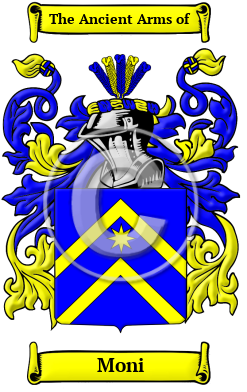
| ![Show Contents]() Moni History, Family Crest & Coats of Arms Moni History, Family Crest & Coats of Arms
Etymology of MoniWhat does the name Moni mean? From the historical and fascinating Italian region of Venice emerged a multitude of noble families, including the distinguished Moni family. Although people were originally known only by a single name, it became necessary for people to adapt a second name to identify themselves as populations grew and travel became more frequent. The process of adopting fixed hereditary surnames was not complete until the modern era, but the use of hereditary family names in Italy began in the 10th and 11th centuries. Italian hereditary surnames were developed according to fairly general principles and they are characterized by a profusion of derivatives coined from given names. Although the most common type of family name found in the region of Venice is the patronymic surname, which is derived from the father's given name, the nickname type of surname is also frequently found. Nickname surnames were derived from an eke-name, or added name. They usually reflected the physical characteristics or attributes of the first person that used the name. The surname Moni came from a "fierce" or "strong man." In some cases, the name Manni may have arisen as an occupational name. Early Origins of the Moni familyThe surname Moni was first found in the city of Cremona. The Manna family records date back to 1037. The Mannino variant is a Sicilian family name originating in San Piero Patti in the Province of Messina in Sicily. Early History of the Moni familyThis web page shows only a small excerpt of our Moni research. The years 1396, 1423, 1459, 1460, 1497, 1571, 1594, 1600, 1609, 1639, 1640, 1663, 1667, 1674, 1697, 1717, 1723, 1776 and 1785 are included under the topic Early Moni History in all our PDF Extended History products and printed products wherever possible. Moni Spelling VariationsSurnames that originated in Italy are characterized by an enormous number of spelling variations. Some of these are derived from regional traditions and dialects. Northern names, for instance, often end in "o", while southern names tend to end in "i". Other variations come from the fact the medieval scribes tended to spell according to the sound of words, rather than any particular set of rules. The recorded variations of Moni include Manni, Manno, Mannelli, Mannello, Mannetti, Mannini, Mannino, Mannucci, Mannuzzi, Mannoni, Mannone, Manneschi, Manelli, Manenti, Manucci, Mannocci, Maniate, Manna, Mannamo, Mannina and many more. Early Notables of the Moni familyGiannozzo Manetti (1396-1459), a Florentine politician and diplomat, and also a significant humanist scholar of the early Italian Renaissance; Vincenzo Manenti (also known as Vincenzio Manenti) (c. 1600-1674), an Italian painter of the Baroque period; Francesco Manelli (Mannelli) (1594-1667), a Roman Baroque composer, particularly of opera, and theorbo player; Carlo Mannelli (1640-1697), an Italian violinist, castrato and composer; Vincenzo Manenti (c. 1600-1674), an Italian painter of the Baroque period; Giannicola Manni, a Perugian painter born in 1460...
Another 76 words (5 lines of text) are included under the topic Early Moni Notables in all our PDF Extended History products and printed products wherever possible.
| Moni migration to the United States | + |
Research into the origins of individual families in North America has revealed records of the immigration of a number of people bearing the name Moni or a variant listed above:
Moni Settlers in United States in the 19th Century- Gabrico De Moni, aged 46, who arrived in New Orleans, La in 1829 1
| Contemporary Notables of the name Moni (post 1700) | + |
- Bradley Moni Mika (b. 1981), New Zealand rugby union player
- Filby, P. William, Meyer, Mary K., Passenger and immigration lists index : a guide to published arrival records of about 500,000 passengers who came to the United States and Canada in the seventeenth, eighteenth, and nineteenth centuries. 1982-1985 Cumulated Supplements in Four Volumes Detroit, Mich. : Gale Research Co., 1985, Print (ISBN 0-8103-1795-8)
 |