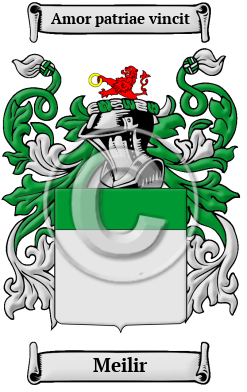
| ![Show Contents]() Meilir History, Family Crest & Coats of Arms Meilir History, Family Crest & Coats of Arms
- Origins Available:
Ireland
Etymology of MeilirWhat does the name Meilir mean? After the forces of Strongbow invaded Ireland they discovered that the Irish had their own system of hereditary surnames. Although the two naming systems had many similarities, occupational surnames, such as Meilir were much more common to the Anglo-Norman culture of the Strongbownians. Occupational surnames were derived from a word describing the actual job done by the initial name bearer. The prefix le, meaning the, in French was often used by the early Strongbownians to link a person's first and name and surname. Eventually these prefixes were dropped or became fused onto the beginning of the surname. The surname came from a common occupational name for an enameler. The surname Meilir is derived from the Old French word esmaileur, which has this meaning. The name Meilir is also occasionally derived from the Welsh personal name Meilyr, which was Maglorix in Old Welsh. The Gaelic forms of the surname Meilir are Maoilir and Mac Maoilir. Early Origins of the Meilir familyThe surname Meilir was first found in Wales. One of the first recorded ancestors bearing this name was Nicholas Meyler, Canon of St. David's in South Wales in 1202. We know that at least one branch of the family accompanied Strongbow, Earl of Pembroke on his invasion of Ireland in 1172. There, settling in Wexford, some of the family adopted the Gaelic of Maoilir, and some even became MacMeyler and McMeyler. George Meyler and Walter Meyler where notables of this branch at Tincurry, Wexford. Meanwhile, a branch of the family settled in Shropshire, where Henry and Walter Meyler were registered in 1273. Meyler de Bermingham (d. before 1275) was an Anglo-Irish lord, founder of Athenry. Meyler was a great-grandson of Robert de Bermingham who is thought to have obtained a grant of Offaly from Strongbow or Henry II about 1172. While his surname was in fact, de Bermingham, it is significant to note the early use of Meyler as a forename. Myler of Tethmoy, who died in 1211, was the son of Robert of Tethmoy, (fl. 1172.) Early History of the Meilir familyThis web page shows only a small excerpt of our Meilir research. More information is included under the topic Early Meilir History in all our PDF Extended History products and printed products wherever possible. Meilir Spelling VariationsSince church officials and medieval scribes spelt each name as it sounded to them; as a result, a single person could accumulate many different versions of his name within official records. A close examination of the origins of the name Meilir revealed the following spelling variations: Meyler, Mailer, Mailler, Mayler, Meiler, Meiller, Maylor, MacMeyler, McMeyler, McMailor, McMeiler, Meilir and many more. Early Notables of the Meilir familyMore information is included under the topic Early Meilir Notables in all our PDF Extended History products and printed products wherever possible. Migration of the Meilir familyIrish immigration to North American began in the late 18th century as many Irish families desired to own their own land. This pattern of immigration grew slowly yet steadily until the 1840s. At that time, a failed crop and a growing population in Ireland resulted in the Great Potato Famine. Poverty, disease, and starvation ravaged the land. To ease their pain and suffering the Irish often looked upon North America as a solution: hundreds of thousands undertook the voyage. Their arrival meant the growth of industry and commerce for British North America and the United States. For the individual Irishman, it meant survival and hope, and the opportunity for work, freedom, and ownership of land. The early immigration and passenger lists revealed many bearing the name Meilir: John Meyler settled in Virginia in 1705; Lewis Meyler settler in Mobile, Ala. in 1856.
The motto was originally a war cry or slogan. Mottoes first began to be shown with arms in the 14th and 15th centuries, but were not in general use until the 17th century. Thus the oldest coats of arms generally do not include a motto. Mottoes seldom form part of the grant of arms: Under most heraldic authorities, a motto is an optional component of the coat of arms, and can be added to or changed at will; many families have chosen not to display a motto.
Motto: Amor patriae vincit
Motto Translation: Patriotism conquers.
 |