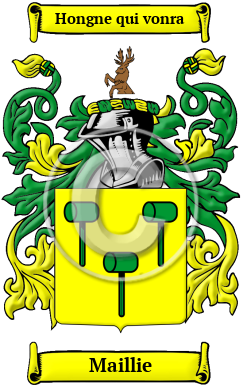
| ![Show Contents]() Maillie History, Family Crest & Coats of Arms Maillie History, Family Crest & Coats of Arms
- Origins Available:
France
Early Origins of the Maillie familyThe surname Maillie was first found in Burgundy (French: Bourgogne), an administrative and historical region of east-central France, where this noted family has held a family seat since ancient times. One of the earliest records of the family was Blessed Jeanne-Marie de Maille (1331-1414), a French Roman Catholic and a member from the Third Order of Saint Francis. Pope Pius IX confirmed her beatification on 27 April 1871. Early History of the Maillie familyThis web page shows only a small excerpt of our Maillie research. Another 292 words (21 lines of text) covering the years 1003, 1050, 1277, 1295, 1331, 1414, 1418, 1474, 1479, 1491, 1532, 1541, 1545, 1656, 1658, 1697, 1710, 1721, 1738 and 1751 are included under the topic Early Maillie History in all our PDF Extended History products and printed products wherever possible. Maillie Spelling VariationsSpelling variations of this family name include: Mailly, Maillie, Mailley, Maillies, Maily, Mailie, Mailey, Mailies, Maillet, Mayie, de Mailly, de Maillie, de Mailley, de Maily, de Mailie, de Mayie, la Mailly, la Maillie, la Mailley, la Maily, de Mayie and many more. Early Notables of the Maillie familyJeanne-Marie de Maille (1331-1414), a French saint; and François de Mailly (1658-1721), a French archbishop and Cardinal, Archbishop of Arles from 1697, then Archbishop of Reims from 1710.
Benoît de Maillet (1656-1738) was a French diplomat and natural historian from Lorraine. He was French consul general at Cairo, and overseer in the Levant. After careful...
Another 53 words (4 lines of text) are included under the topic Early Maillie Notables in all our PDF Extended History products and printed products wherever possible.
| Maillie migration to the United States | + |
Maillie Settlers in United States in the 19th Century- Daniel Maillie, who settled in Philadelphia in 1880
The motto was originally a war cry or slogan. Mottoes first began to be shown with arms in the 14th and 15th centuries, but were not in general use until the 17th century. Thus the oldest coats of arms generally do not include a motto. Mottoes seldom form part of the grant of arms: Under most heraldic authorities, a motto is an optional component of the coat of arms, and can be added to or changed at will; many families have chosen not to display a motto.
Motto: Hongne qui vonra
 |