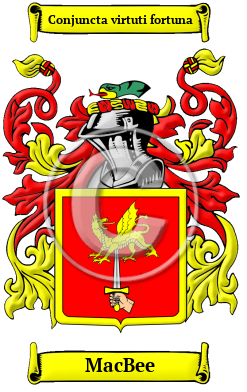
![Show Contents]() MacBee History, Family Crest & Coats of Arms MacBee History, Family Crest & Coats of Arms
- Origins Available:
Scotland
Etymology of MacBeeWhat does the name MacBee mean? The western coast of Scotland and the desolate Hebrides islands are the ancient home of the MacBee family. Their name is derived from the names of Macbeth and Bethune, or Beaton. The Macbeth and Bethune families, who were hereditary physicians to the Chiefs of Macdonald, practiced medicine on the Isles during the Middle Ages and their names merged in English into the one surname of Beaton. The Macbeths were concentrated in Islay and Mull, whereas the Beatons were concentrated in Skye. Early Origins of the MacBee familyThe surname MacBee was first found in the Isle of Islay, where legend has it that the progenitor of this Clan is none other than Macbeth (Mac Bethad mac Findláich) (1005-1057), the High Steward of Moray. As his mother was a daughter of King Kenneth III, and he married Grudoch, a daughter of the son of King Kenneth III, he had as much of a claim to the Scottish throne as King Duncan I. MacBeth, therefore, challenged Duncan and defeated him in battle in 1040, assuming the throne. Known in English simply as Macbeth, he was last Celtic king of Scotland, ruling from 1040 to 1057, when he died in battle against future king Malcolm of the Canmore dynasty. He is best known through the Shakespearean drama bearing his name. Thespians rarely mention the play by the name and typically call it "the Scottish play" as they believe that by uttering the name brings one bad luck. Early History of the MacBee familyThis web page shows only a small excerpt of our MacBee research. Another 184 words (13 lines of text) covering the years 1545, 1600, 1609 and 1763 are included under the topic Early MacBee History in all our PDF Extended History products and printed products wherever possible. MacBee Spelling VariationsMedieval translation of Gaelic names could not be referred to as an accurate process. Spelling was not yet standardized, and names in documents from that era are riddled with spelling variations. MacBee has been written as McBeth, Beaton, Beeton, MacBeth, MacBeaton, McBee and many more. Early Notables of the MacBee familyMore information is included under the topic Early MacBee Notables in all our PDF Extended History products and printed products wherever possible. Migration of the MacBee familyMany of the ancestors of Dalriadan families who arrived in North America still live in communities along the east coast of Canada and the United States. In the American War of Independence many of the original settlers traveled north to Canada as United Empire Loyalists. In the late 19th and early 20th centuries the ancestors of many Scots began recovering their collective national heritage through Clan societies, highland games, and other patriotic events. Research into the origins of individual families in North America revealed records of the immigration of a number of people bearing the name MacBee or a variant listed above: Alexander McBeth, his wife and their 7 children, who arrived in Canada in 1815; Alexander McBeth, who came to New York in 1802; Charles McBeth, who was naturalized in South Carolina in 1804.
The motto was originally a war cry or slogan. Mottoes first began to be shown with arms in the 14th and 15th centuries, but were not in general use until the 17th century. Thus the oldest coats of arms generally do not include a motto. Mottoes seldom form part of the grant of arms: Under most heraldic authorities, a motto is an optional component of the coat of arms, and can be added to or changed at will; many families have chosen not to display a motto.
Motto: Conjuncta virtuti fortuna
Motto Translation: Good fortune is allied to bravery
 |