| ![Show Contents]() Linnan History, Family Crest & Coats of Arms Linnan History, Family Crest & Coats of Arms
Etymology of LinnanWhat does the name Linnan mean? The Linnan surname is an Anglicized form of Gaelic Mac Gille Fhinneain, a patronymic name created from a Gaelic personal name "Fionnán," from the Gaelic "fionn," meaning "white." Early Origins of the Linnan familyThe surname Linnan was first found in Ayrshire where their history vitally is enmeshed with that of the larger Logan Clan. The Linnan spelling of this name was first found in Druimdeurfait, in Ross-shire, where they were a branch of the Highland Logans, who lived along Loch Lochy. According to family lore, they descend from Gilliegorm, Chief of the northern Logans, who was killed battling the Clan Fraser. His pregnant wife taken captive by Lord Lovat. Her son, born humped back, was called Crotair MacGilliegorm, the "crooked-back son of Gilliegorm." Fearing future revenge on the Frasers by the boy, he was sent to a monastery at Beauly, where he became a monk. He was said to be an ardent follower of the Irish Saint Fhinan, and one of his children took the name Mac Gillie Fhinan, which eventually became MacLennan. Early History of the Linnan familyThis web page shows only a small excerpt of our Linnan research. Another 247 words (18 lines of text) covering the years 1204, 1296, 1329, 1555, 1606, 1609, 1746 and 1890 are included under the topic Early Linnan History in all our PDF Extended History products and printed products wherever possible. Linnan Spelling VariationsBoernician names that evolved in the largely preliterate Middle Ages are often marked by considerable spelling variations. Linnan has been spelled MacLennan, MacLenan, McLennan, McLennen and many more. Early Notables of the Linnan familyMore information is included under the topic Early Linnan Notables in all our PDF Extended History products and printed products wherever possible. Migration of the Linnan family to IrelandSome of the Linnan family moved to Ireland, but this topic is not covered in this excerpt.
Another 61 words (4 lines of text) about their life in Ireland is included in all our PDF Extended History products and printed products wherever possible.
| Linnan migration to the United States | + |
Some of the Boernician-Scottish Clan families who came to North America were Loyalists who went north to Canada after the American War of Independence. Families on both sides of the border went on to found two of the world's great nations. This century, families with Scottish roots have rediscovered their heritage through highland games and Clan societies. An inquiry into the early roots of North American families reveals a number of immigrants bearing the name Linnan or a variant listed above:
Linnan Settlers in United States in the 19th Century- John Linnan, who arrived in New York, NY in 1816 1
| Contemporary Notables of the name Linnan (post 1700) | + |
- Luke E. Linnan (b. 1895), American Democratic Party politician, Delegate to Democratic National Convention from Iowa, 1936, 1940; Justice of Iowa State Supreme Court, 1958 2
The motto was originally a war cry or slogan. Mottoes first began to be shown with arms in the 14th and 15th centuries, but were not in general use until the 17th century. Thus the oldest coats of arms generally do not include a motto. Mottoes seldom form part of the grant of arms: Under most heraldic authorities, a motto is an optional component of the coat of arms, and can be added to or changed at will; many families have chosen not to display a motto.
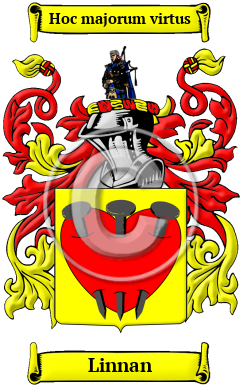
Motto: Hoc majorum virtus
Motto Translation: This is the valour of my ancestors.
- Filby, P. William, Meyer, Mary K., Passenger and immigration lists index : a guide to published arrival records of about 500,000 passengers who came to the United States and Canada in the seventeenth, eighteenth, and nineteenth centuries. 1982-1985 Cumulated Supplements in Four Volumes Detroit, Mich. : Gale Research Co., 1985, Print (ISBN 0-8103-1795-8)
- The Political Graveyard: Alphabetical Name Index. (Retrieved 2015, November 4) . Retrieved from http://politicalgraveyard.com/alpha/index.html
 |