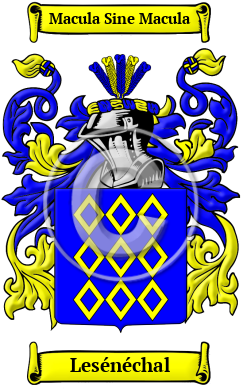
| ![Show Contents]() Lesénéchal History, Family Crest & Coats of Arms Lesénéchal History, Family Crest & Coats of Arms
Etymology of LesénéchalWhat does the name Lesénéchal mean? The French family name Lesénéchal dates back to the Middle Ages. It was a Norman name given to a seneschal, a steward or official in the household of a sovereign or great noble, to whom the administration of justice and domestic arrangements were entrusted. Early Origins of the Lesénéchal familyThe surname Lesénéchal was first found in Normandy (French: Normandie), the former Duchy of Normandy, where this distinguished family held a family seat at Crèvecoeur in the arrondissement of Lisieux where Hamon Le Sénéchal held a strong castle that still remains in the valley of Auge. He was directly descended from Hamon-Aux-Dents, Lord of Thorigny who was killed in the battle of Val-ès-Dunes in 1045. Hamon, his nephew of the family of Crèvecoeur, was present at the battle of Hastings in 1066. Early History of the Lesénéchal familyThis web page shows only a small excerpt of our Lesénéchal research. Another 60 words (4 lines of text) covering the years 1624 and 1719 are included under the topic Early Lesénéchal History in all our PDF Extended History products and printed products wherever possible. Lesénéchal Spelling VariationsOne can encounter great variation in the spelling of French surnames; in part, as spelling, and the spelling names was not yet standardized during the early development of the written French language. Later, there was much branching and movement of families, and spellings would change according to region. Variations of the name Lesénéchal include Sénéchal, Le Sénéchal, Sénéschal, Le Sénéschal, Sénécal, Sénégal, Sénécot, Sénécaut, Sénécaux, Seneschal and many more. Early Notables of the Lesénéchal familyMore information is included under the topic Early Lesénéchal Notables in all our PDF Extended History products and printed products wherever possible. Migration of the Lesénéchal familyIn 1643, 109 years after the first landings by Cartier, there were only about 300 people in Quebec, in 1663 there were only 500, 2,000 migrants arrived during the next decade. Early marriage was desperately encouraged amongst the immigrants. Youths of 18 took fourteen-year-old girls for their wives. The fur trade was developed and attracted migrants, both noble and commoner from France. 15,000 explorers left Montreal in the late 17th and 18th centuries. Migration from France to New France or Quebec as it was now more popularly called, continued from France until it fell in 1759. By 1675, there were 7000 French in Quebec. By the same year the Acadian presence in Nova Scotia, New Brunswick and Prince Edward Island had reached 500. In 1755, 10,000 French Acadians refused to take an oath of allegiance to England and were deported to Louisiana. Meanwhile, in Quebec, the French race flourished, founding in Lower Canada, one of the two great solitudes which became Canada. Many distinguished contributions have been made by members of this family name Lesénéchal. It has been prominent in the arts, religion, politics and culture in France and New France. Amongst the settlers in North America with this distinguished name Lesénéchal were Claude Senecal with his wife Elisabeth and daughter who arrived in Louisiana in 1719; Jean Sénécal (1669), Jean Sénécal (1672), Adrian Sé.
| Contemporary Notables of the name Lesénéchal (post 1700) | + |
- ? Le Sénéchal de Kerkado (1786-1805), French composer who had her first opera performed at the age of nineteen
The motto was originally a war cry or slogan. Mottoes first began to be shown with arms in the 14th and 15th centuries, but were not in general use until the 17th century. Thus the oldest coats of arms generally do not include a motto. Mottoes seldom form part of the grant of arms: Under most heraldic authorities, a motto is an optional component of the coat of arms, and can be added to or changed at will; many families have chosen not to display a motto.
Motto: Macula Sine Macula
Motto Translation: A mark without flaw
 |