| ![Show Contents]() Learthley History, Family Crest & Coats of Arms Learthley History, Family Crest & Coats of Arms
- Origins Available:
England
Early Origins of the Learthley familyThe surname Learthley was first found in "Leathes and Dalehead, co. Cumberland [where they were] seated at the former place shortly after the Conquest; the last male heir, Thomas Leathes, Esq., d. in 1806." 1 2 Later, in Yorkshire Gilbert del Lathes was listed as Freeman of York in 1296. A few years later, Richard del Lathes was listed in the Subsidy Rolls of Lancashire in 1332. Another source notes "this surname is derived from a geographical locality. 'of the lathes,' i.e. the barns, the grange. The surname has arisen in several localities. Lathes is a hamlet next unto Warnpool and was so called of a grange or farm which the Lord of Whitrigg had there. Of that place the family of the Lathes took their name until Adam Leathes, now owner of the demesne thereof, sold the tenements and residue of the hamlet to the inhabitants. It was given by Robert, the son of Robert de Dunbretton, to his kinsman Henry, whose posterity were thereupon called Leaths' "Appended is a quotation: 'Robertas filius Roberti dedit Leathes Henrico fratri suo, Henry III' 3 Thomas atte Lathe was rector of Stokesby, Norfolk in 1356. 'The manor house was lately called the Lathes, it stands a little distance from Pokethorp Street.' Pokethorp Manor, Norwich." 4 The same source also notes "John Corbet (4 Edward VI), had a lease of the Cellerie's, or St. Leonard's meadow, containing six acres, lying between the river and street, the Lathis close, and fold-course, and liberty of shak in the manor house and yard, and all thereon built, called the Lathe-yard" 4 Adam del Laythes was registered in the Subsidy Rolls for Cumberland in 1332. Records of the Yorkshire Poll Tax Rolls of 1379 show John de Leth as holding lands there at that time. Henry Latheman was recorded in the Assize Rolls for Lancashire in 1278. 5 Reaney notes the name literally means 'worker at the barn(s) from the Old Norse word 'hlaða' Leath is a Lancashire and Cumberland dialect form of the name. 5 Early History of the Learthley familyThis web page shows only a small excerpt of our Learthley research. Another 79 words (6 lines of text) covering the years 1070, 1468 and 1741 are included under the topic Early Learthley History in all our PDF Extended History products and printed products wherever possible. Learthley Spelling VariationsLearthley has been spelled many different ways. Before English spelling became standardized over the last few hundred years, spelling variations in names were a common occurrence. As the English language changed in the Middle Ages, absorbing pieces of Latin and French, as well as other languages, the spelling of people's names also changed considerably, even over a single lifetime. Spelling variants included: Leathes, Lethes, Lerthes, Leathley and others. Early Notables of the Learthley familyMore information is included under the topic Early Learthley Notables in all our PDF Extended History products and printed products wherever possible. Migration of the Learthley familyIn an attempt to escape the chaos experienced in England, many English families boarded overcrowded and diseased ships sailing for the shores of North America and other British colonies. Those families hardy enough, and lucky enough, to make the passage intact were rewarded with land and a social environment less prone to religious and political persecution. Many of these families became important contributors to the young colonies in which they settled. Early immigration and passenger lists have documented some of the first Learthleys to arrive on North American shores: William Leathes, recorded in New York city in 1711.
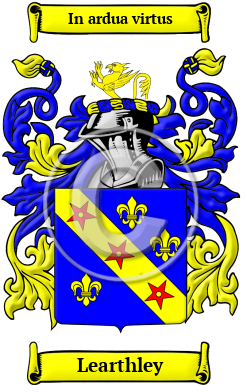
The motto was originally a war cry or slogan. Mottoes first began to be shown with arms in the 14th and 15th centuries, but were not in general use until the 17th century. Thus the oldest coats of arms generally do not include a motto. Mottoes seldom form part of the grant of arms: Under most heraldic authorities, a motto is an optional component of the coat of arms, and can be added to or changed at will; many families have chosen not to display a motto.
Motto: In ardua virtus
Motto Translation: Virtue against difficulties.
- Burke, Sir Bernard, C.B. LL.D The General Armory of England Scotland, Ireland and Wales. London: Harrison, 59, Pall Mall, 1884, Print.
- Lower, Mark Anthony, Patronymica Britannica, A Dictionary of Family Names of the United Kingdom. London: John Russel Smith, 1860. Print.
- Bardsley, C.W, A Dictionary of English and Welsh Surnames: With Special American Instances. Wiltshire: Heraldry Today, 1901. Print. (ISBN 0-900455-44-6)
- Rye, Walter, A History of Norfolk. London: Elliot Stock, 62, Paternoster Row, 1885. Print
- Reaney, P.H and R.M. Wilson, A Dictionary of English Surnames. London: Routledge, 1991. Print. (ISBN 0-415-05737-X)
 |