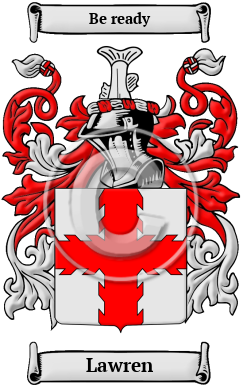
| ![Show Contents]() Lawren History, Family Crest & Coats of Arms Lawren History, Family Crest & Coats of Arms
- Origins Available:
England
Etymology of LawrenWhat does the name Lawren mean? Lawren is a name that dates far back into the mists of early British history to the days of the Anglo-Saxon tribes. It is derived from the name Lawrence. This name is in turn derived from the Latin name Laurentius, which literally means man from Laurentium, a town in Italy named for its laurels or bay trees. The popularity of this name in medieval Europe is due to the exploits of a saint who was martyred at Rome in the 3rd century. Early Origins of the Lawren familyThe surname Lawren was first found in Lancashire at Yealand-Redmayne, a township, in the parish of Warton, union of Lancaster, hundred of Lonsdale south of the Sands. "Yealand Hall, an ancient dwelling at Yealand-Storrs in the township, seems to have been possessed in the reign of Henry VIII. by the family of Lawrence, who held the manor of "Yeland-Redmayn" as of the manor of Warton." 1 Early History of the Lawren familyThis web page shows only a small excerpt of our Lawren research. Another 103 words (7 lines of text) covering the years 1150, 1252, 1598, 1614, 1618, 1635, 1657, 1664, 1665, 1672, 1674, 1691, 1692 and 1699 are included under the topic Early Lawren History in all our PDF Extended History products and printed products wherever possible. Lawren Spelling VariationsIt is only in the last few hundred years that the English language has been standardized. For that reason, early Anglo-Saxon surnames like Lawren are characterized by many spelling variations. As the English language changed and incorporated elements of other European languages, even literate people changed the spelling of their names. The variations of the name Lawren include: Lawrence, Laurence, Lawerence, Lawrance and many more. Early Notables of the Lawren family- Sir John Lawrence (died 1692), an English merchant and politician, Lord Mayor of the City of London (1664-1665)
- John Lawrence (1618-1699), English-born immigrant to Plymouth in 1635 from St Albans, Hertfordshire, he later became Mayor of New York City from 1672 to 1674, and again in 1691
Migration of the Lawren familyMany English families tired of political and religious strife left Britain for the new colonies in North America. Although the trip itself offered no relief - conditions on the ships were extremely cramped, and many travelers arrived diseased, starving, and destitute - these immigrants believed the opportunities that awaited them were worth the risks. Once in the colonies, many of the families did indeed prosper and, in turn, made significant contributions to the culture and economies of the growing colonies. An inquiry into the early roots of North American families has revealed a number of immigrants bearing the name Lawren or a variant listed above: George and Elizabeth Lawrance, who settled in Virginia in 1641; Anne and John Lawrence settled in Virginia with their seven children in 1676; Ben, Edward, Elizabeth, J.R. John, Joseph, Lewis, Mary, Phillip, Thomas, and William Lawrence, all arrived in Philadelphia between 1840 and 1860..
| Contemporary Notables of the name Lawren (post 1700) | + |
- Lawren Harris (1886-1949), Canadian painter, founding member of the "Group of Seven"
The motto was originally a war cry or slogan. Mottoes first began to be shown with arms in the 14th and 15th centuries, but were not in general use until the 17th century. Thus the oldest coats of arms generally do not include a motto. Mottoes seldom form part of the grant of arms: Under most heraldic authorities, a motto is an optional component of the coat of arms, and can be added to or changed at will; many families have chosen not to display a motto.
Motto: Be ready
- Lewis, Samuel, A Topographical Dictionary of England. Institute of Historical Research, 1848, Print.
 |