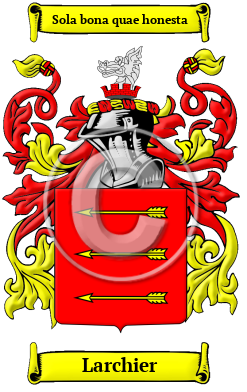
Larchier is a name that was carried to England in the great wave of migration from Normandy following the Norman Conquest of 1066. It is a name for a bowman or archer. The surname Larchier was originally derived from the Old French word archer, and the preposition le, which means the, which is abbreviated to l' when placed next to a vowel, as in l'archer.
Loading...
Early Origins of the Larchier family
The surname Larchier was first found in Derbyshire and Nottingham, where they were granted lands by King William, Duke of Normandy, for their assistance at the Battle of Hastings in 1066 A.D. William L'Archairus, was General of bowmen for Duke William, and he was granted the Hundred of Sunburne in Hampshire in the year 1086. He was so recorded in the Domesday Book. Both William L'Archer and his son were, according to Barlow, and his "Peerage of England," at the Conquest.
Early History of the Larchier family
This web page shows only a small excerpt of our Larchier research. Another 85 words (6 lines of text) covering the year 1778 is included under the topic Early Larchier History in all our PDF Extended History products and printed products wherever possible.
Larchier Spelling Variations
The English language only became standardized in the last few centuries. For that reason, spelling variations are common among many Anglo-Norman names. The shape of the English language was frequently changed with the introduction of elements of Norman French, Latin, and other European languages; even the spelling of literate people's names were subsequently modified. Larchier has been recorded under many different variations, including Larcher, Lercher, Lurcher, Larchier and others.
Early Notables of the Larchier family
More information is included under the topic Early Larchier Notables in all our PDF Extended History products and printed products wherever possible.
Loading...
Loading...
Loading...
Loading...
Migration of the Larchier family
To escape the uncertainty of the political and religious uncertainty found in England, many English families boarded ships at great expense to sail for the colonies held by Britain. The passages were expensive, though, and the boats were unsafe, overcrowded, and ridden with disease. Those who were hardy and lucky enough to make the passage intact were rewarded with land, opportunity, and social environment less prone to religious and political persecution. Many of these families went on to be important contributors to the young nations of Canada and the United States where they settled. Larchiers were some of the first of the immigrants to arrive in North America: Joseph Larcher who landed in North America in 1771.
The motto was originally a war cry or slogan. Mottoes first began to be shown with arms in the 14th and 15th centuries, but were not in general use until the 17th century. Thus the oldest coats of arms generally do not include a motto. Mottoes seldom form part of the grant of arms: Under most heraldic authorities, a motto is an optional component of the coat of arms, and can be added to or changed at will; many families have chosen not to display a motto.
Motto: Sola bona quae honesta Motto Translation: Those things only are good which are honest.
Remove Item
WARNING!
Removing this item from your shopping cart will remove your associated sale items.
Are you sure you want to delete this item from your shopping cart?