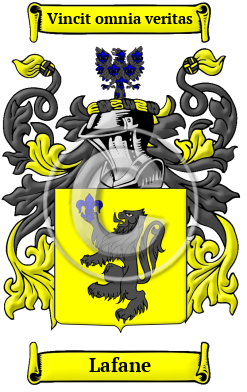
The surname Lafane is derived from a child. The surname Lafane is derived from the French "l'enfant," or perhaps from La Font or La Fin, which are both found in French records.
Loading...
Early Origins of the Lafane family
The surname Lafane was first found in counties Tipperary and Wexford (Irish: Loch Garman), founded by Vikings as Waesfjord, and located in Southeastern Ireland, in the province of Leinster, where they were granted lands by Strongbow after the invasion of Ireland in 1172.
Early History of the Lafane family
This web page shows only a small excerpt of our Lafane research. Another 89 words (6 lines of text) covering the year 1200 is included under the topic Early Lafane History in all our PDF Extended History products and printed products wherever possible.
Lafane Spelling Variations
During the lifetime of an individual person, his name was often spelt by church officials and medieval scribes the way it sounded. An examination of the many different origins of each name has revealed many spelling variations for the name: Laffan, Laffin, La Font, Laffhan and others.
Early Notables of the Lafane family
More information is included under the topic Early Lafane Notables in all our PDF Extended History products and printed products wherever possible.
Loading...
Loading...
Loading...
Loading...
Migration of the Lafane family
Ireland's Great Potato Famine left the country's inhabitants in extreme poverty and starvation. Many families left their homeland for North America for the promise of work, freedom and land ownership. Although the Irish were not free of economic and racial discrimination in North America, they did contribute greatly to the rapid development of bridges, canals, roads, and railways. Eventually, they would be accepted in other areas such as commerce, education, and the arts. An examination of immigration and passenger lists revealed many bearing the name Lafane: John Laffan, whose marriage was recorded in Nova Scotia in 1815; Patrick Laffin, who was recorded in Boston in 1818; Edward Laffin, along with his sister Mary and brother Peter, who arrived in Halifax, Nova Scotia in 1805.
The motto was originally a war cry or slogan. Mottoes first began to be shown with arms in the 14th and 15th centuries, but were not in general use until the 17th century. Thus the oldest coats of arms generally do not include a motto. Mottoes seldom form part of the grant of arms: Under most heraldic authorities, a motto is an optional component of the coat of arms, and can be added to or changed at will; many families have chosen not to display a motto.
Motto: Vincit omnia veritas Motto Translation: Truth conquers all things.
Remove Item
WARNING!
Removing this item from your shopping cart will remove your associated sale items.
Are you sure you want to delete this item from your shopping cart?
HouseofNames E-Newsletter Sign Up
On Demand Gifts | Digital Products Available 24/7
A Gift for Everyone on your List is a Click Away - Shop Now