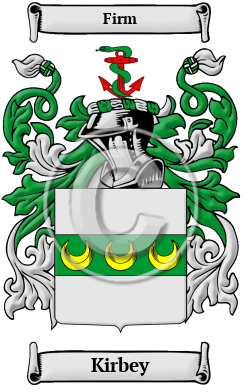
| ![Show Contents]() Kirbey History, Family Crest & Coats of Arms Kirbey History, Family Crest & Coats of Arms
Etymology of KirbeyWhat does the name Kirbey mean? When the ancestors of the Kirbey family emigrated to England following the Norman Conquest in 1066 they brought their family name with them. They lived at Kirkby in Furness. The name Kirkby means village with a church. 1 Early Origins of the Kirbey familyThe surname Kirbey was first found in Lancashire. One of the first recorded references to the name was John Kirkby (died 26 March 1290,) an English ecclesiastic and statesman. "John de Kirkeby, [was] Bishop of Ely in 1286, and founder of Ely Palace, Holborn." 2 He acted as keeper of the great seal during the frequent absences of the chancellor, Robert Burnell, during the reign of Henry III. He was Lord Treasurer from January 1284 to his death. On 26 July 1286, he was elected Bishop of Ely, a post he held until his death. Another John de Kirkby (d. 1352) was Bishop of Carlisle, an Augustinian canon at Carlisle and later prior of the house. Early History of the Kirbey familyThis web page shows only a small excerpt of our Kirbey research. Another 128 words (9 lines of text) covering the years 1548, 1549, 1582, 1625, 1634, 1649, 1658, 1661, 1681, 1690, 1693, 1702, 1703, 1708, 1709, 1753, 1759, 1781, 1816, 1823, 1834, 1850 and 1853 are included under the topic Early Kirbey History in all our PDF Extended History products and printed products wherever possible. Kirbey Spelling VariationsSpelling variations in names were a common occurrence in the eras before English spelling was standardized a few hundred years ago. In the Middle Ages, even the literate regularly changed the spellings of their names as the English language incorporated elements of French, Latin, and other European languages. Many variations of the name Kirbey have been found, including Kirkby, Kirby, Kerribly, Kerwick, O'Kerwick and many more. Early Notables of the Kirbey familyThomas Kirkby, rector of the church of St. Michael in Aughton, Lancashire in 1548 3; John Kirby (1690-1753), an English land surveyor and topographer, best known for his book The Suffolk Traveller; Richard Kirkby (c.1625-1681), an English politician, from Kirkby Ireleth in Lancashire. He was a Justice of the Peace and Member of Parliament for Lancaster (1661-1681). His son Colonel Roger Kirkby (c.1649-1709) was an English soldier and politician. He was Governor of Chester from 1693 until 1702, and was chosen High Sheriff of Lancashire in 1708. Captain Richard Kirkby (c.1658-1703), was an English officer of the Royal Navy convicted of...
Another 130 words (9 lines of text) are included under the topic Early Kirbey Notables in all our PDF Extended History products and printed products wherever possible. Migration of the Kirbey family to IrelandSome of the Kirbey family moved to Ireland, but this topic is not covered in this excerpt.
Another 43 words (3 lines of text) about their life in Ireland is included in all our PDF Extended History products and printed products wherever possible. Migration of the Kirbey familyFor many English families, the social climate in England was oppressive and lacked opportunity for change. For such families, the shores of Ireland, Australia, and the New World beckoned. They left their homeland at great expense in ships that were overcrowded and full of disease. Many arrived after the long voyage sick, starving, and without a penny. But even those were greeted with greater opportunity than they could have experienced back home. Numerous English settlers who arrived in the United States and Canada at this time went on to make important contributions to the developing cultures of those countries. Many of those families went on to make significant contributions to the rapidly developing colonies in which they settled. Early North American records indicate many people bearing the name Kirbey were among those contributors: Thomas Kirby settled in Barbados in 1663; along with Rebecca and Henry; James Kirby settled in Virginia in 1651 along with Humphrey and Alice his wife.
The motto was originally a war cry or slogan. Mottoes first began to be shown with arms in the 14th and 15th centuries, but were not in general use until the 17th century. Thus the oldest coats of arms generally do not include a motto. Mottoes seldom form part of the grant of arms: Under most heraldic authorities, a motto is an optional component of the coat of arms, and can be added to or changed at will; many families have chosen not to display a motto.
Motto: Firm
- Mills, A.D., Dictionary of English Place-Names. Oxford: Oxford University Press, 1991. Print. (ISBN 0-19-869156-4)
- Lewis, Samuel, A Topographical Dictionary of England. Institute of Historical Research, 1848, Print.
- 'Townships: Scarisbrick', in A History of the County of Lancaster: Volume 3, ed. William Farrer and J Brownbill (London, 1907), pp. 265-276. British History Online http://www.british-history.ac.uk/vch/lancs/vol3/pp265-276 [accessed 21 January 2017].
 |