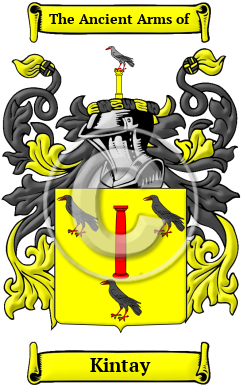
| ![Show Contents]() Kintay History, Family Crest & Coats of Arms Kintay History, Family Crest & Coats of Arms
- Origins Available:
England
Etymology of KintayWhat does the name Kintay mean? The name Kintay reached English shores for the first time with the ancestors of the Kintay family as they migrated following the Norman Conquest of 1066. The Kintay family lived in Kinder, Derbyshire. The surname of Kinder was a local name which means of Kinder, a hamlet in the parish of Glossop, Derbyshire, near Chapel-en-le-Frith. 1 "Kinder may represent a Norse. personal name (cp. Dano-Norwegian kiender, ‘skilful man’)." 2 Early Origins of the Kintay familyThe surname Kintay was first found in Derbyshire where they held a family seat at Kinder, a small hamlet originally called Chendre before the taking of the Domesday Book census. 3 Kinder is a hamlet near the Kinder Scout, the highest and best known mountain in the Peak District of Derbyshire, and is often called 'The Peak'. 4 At the time of the taking of the Domesday Book, 5 the hamlet of Kinder was "King's Land." It is here that we find the first record of the family in early rolls. Philota de Kender was recorded in the Hundredorum Rolls of 1274 for Derybyshire. 6 Much later, Hugh Kynder was listed in London in 1419 and Margaret Kyndur was recorded in Cheshire in 1492. 7 Early History of the Kintay familyThis web page shows only a small excerpt of our Kintay research. Another 161 words (12 lines of text) covering the years 1576, 1581, 1597, 1703, 1752, 1800, 1819, 1852, 1855, 1863, 1868, 1903 and 1936 are included under the topic Early Kintay History in all our PDF Extended History products and printed products wherever possible. Kintay Spelling VariationsAnglo-Norman names tend to be marked by an enormous number of spelling variations. This is largely due to the fact that Old and Middle English lacked any spelling rules when Norman French was introduced in the 11th century. The languages of the English courts at that time were French and Latin. These various languages mixed quite freely in the evolving social milieu. The final element of this mix is that medieval scribes spelled words according to their sounds rather than any definite rules, so a name was often spelled in as many different ways as the number of documents it appeared in. The name was spelled Kinder, Kynder, Chinder, Chendre, Kender, Kyender and others. Early Notables of the Kintay familyPhillip Kinder (born 1597), also Kynder, an English writer from Nottinghamshire. His "Booke," a collection of oberservations, letters and poems is preserved in the Bodleian Library. 8
John Kinder (1819-1903) was a London-born, New Zealand Anglican clergyman, teacher, artist and photographer. He emigrated to Auckland, New Zealand in July 1855 to become headmaster of the Church of England Grammar School...
Another 58 words (4 lines of text) are included under the topic Early Kintay Notables in all our PDF Extended History products and printed products wherever possible. Migration of the Kintay familyBecause of the political and religious discontent in England, families began to migrate abroad in enormous numbers. Faced with persecution and starvation at home, the open frontiers and generally less oppressive social environment of the New World seemed tantalizing indeed to many English people. The trip was difficult, and not all made it unscathed, but many of those who did get to Canada and the United States made important contributions to the young nations in which they settled. Some of the first North American settlers with Kintay name or one of its variants: Bastian Kender who settled in Philadelphia, Pennsylvania in 1752; Anna Eva Kendar who settled in Charles Town [Charleston], South Carolina in 1763; Caspar and George Kinder settled in Philadelphia, Pennsylvania in 1738.
- Lower, Mark Anthony, Patronymica Britannica, A Dictionary of Family Names of the United Kingdom. London: John Russel Smith, 1860. Print.
- Harrison, Henry, Surnames of the United Kingdom: A Concise Etymological Dictionary Baltimore: Geneological Publishing Company, 2013. Print
- Mills, A.D., Dictionary of English Place-Names. Oxford: Oxford University Press, 1991. Print. (ISBN 0-19-869156-4)
- Lewis, Samuel, A Topographical Dictionary of England. Institute of Historical Research, 1848, Print.
- Williams, Dr Ann. And G.H. Martin, Eds., Domesday Book A Complete Translation. London: Penguin, 1992. Print. (ISBN 0-141-00523-8)
- Bardsley, C.W, A Dictionary of English and Welsh Surnames: With Special American Instances. Wiltshire: Heraldry Today, 1901. Print. (ISBN 0-900455-44-6)
- Reaney, P.H and R.M. Wilson, A Dictionary of English Surnames. London: Routledge, 1991. Print. (ISBN 0-415-05737-X)
- Lee, Sir Stanley, Dictionary of National Biography. London: The MacMillan Company 1909. Print
 |