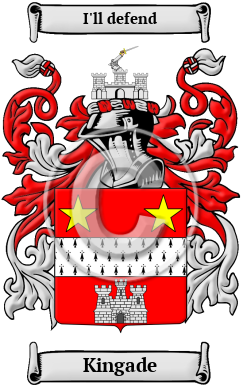
| ![Show Contents]() Kingade History, Family Crest & Coats of Arms Kingade History, Family Crest & Coats of Arms
- Origins Available:
Scotland
Ireland
Etymology of KingadeWhat does the name Kingade mean? Among the all the peoples of ancient Scotland, the first to use the name Kingade were the Strathclyde-Britons. It was a name for someone who lived at Kincaid in the county of Stirlingshire. The name of Kincaith, from which the family derive their name is almost certainly of Gaelic origin, coming from the Gaelic words "ceann", meaning top or head and "caithe", meaning pass. 1 2 Early Origins of the Kingade familyThe surname Kingade was first found in Stirlingshire. The earliest evidence of the surname Kingade was found in the parish of Campsie, Stirlingshire north of Glasgow. 3 Early History of the Kingade familyThis web page shows only a small excerpt of our Kingade research. Another 171 words (12 lines of text) covering the years 1450, 1457, 1467, 1493, 1545, 1579, 1600, 1609, 1660, 1661, 1687, 1726, 1787, 1815, 1840 and 1902 are included under the topic Early Kingade History in all our PDF Extended History products and printed products wherever possible. Kingade Spelling VariationsThe variation in the spelling of Medieval names is a result of the lack of spelling rules in the English language prior to the last few hundred years. Before that time, scribes spelled according to sound, often varying the spelling of name within a single document. Kingade has appeared as Kincaid, Kinkeed, Kincade, Kyncade, Kinkaid and many more. Early Notables of the Kingade familyJean Kincaid (1579-1600) who led an unfortunate life with a brutal husband, John Kincaid of Warriston. Eventually, his violent ways became too much for her to bear and she incited a servant of hers named Robert Weir, to batter the man to death with his bare fists. He was admitted by Mrs. Kincaid into her husband's chamber in his house at Warriston at an early hour on the morning of Tuesday, 1 July 1600, and he killed Kincaid with his fists. News of the murder quickly reached Edinburgh, and 'the Lady Warristoun,' 'the fause nourise,' and her two 'hyred women,' were...
Another 171 words (12 lines of text) are included under the topic Early Kingade Notables in all our PDF Extended History products and printed products wherever possible. Migration of the Kingade family to IrelandSome of the Kingade family moved to Ireland, but this topic is not covered in this excerpt.
Another 121 words (9 lines of text) about their life in Ireland is included in all our PDF Extended History products and printed products wherever possible. Migration of the Kingade familyAs the persecution of Clan families continued, they sailed for North America in increasing numbers. In most cases, they found the freedom and opportunity they sought. Land was often available and the American War of Independence allowed Scots an opportunity to solidify their independence from the English crown. These settlers and their ancestors went on to play essential roles in the forging of the nations of the United States and Canada. Among them: John Kincaid, who was the first Kincaid in North America, landing at Perth Amboy, New Jersey in 1683; John Kincaid, who settled in New Jersey in 1685; James Kincaid, who settled in Alexandria Virginia in 1807.
The motto was originally a war cry or slogan. Mottoes first began to be shown with arms in the 14th and 15th centuries, but were not in general use until the 17th century. Thus the oldest coats of arms generally do not include a motto. Mottoes seldom form part of the grant of arms: Under most heraldic authorities, a motto is an optional component of the coat of arms, and can be added to or changed at will; many families have chosen not to display a motto.
Motto: I'll defend
- Smith, Eldson Coles, New Dictionary of American Family Names New York: Harper & Row, 1956. Print
- Lower, Mark Anthony, Patronymica Britannica, A Dictionary of Family Names of the United Kingdom. London: John Russel Smith, 1860. Print.
- Black, George F., The Surnames of Scotland Their Origin, Meaning and History. New York: New York Public Library, 1946. Print. (ISBN 0-87104-172-3)
 |