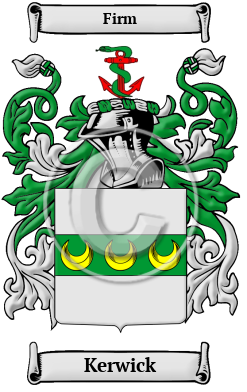
| ![Show Contents]() Kerwick History, Family Crest & Coats of Arms Kerwick History, Family Crest & Coats of Arms
Etymology of KerwickWhat does the name Kerwick mean? Kerwick is one of the thousands of new names that the Norman Conquest brought to England in 1066. The Kerwick family lived at Kirkby in Furness. The name Kirkby means village with a church. 1 Early Origins of the Kerwick familyThe surname Kerwick was first found in Lancashire. One of the first recorded references to the name was John Kirkby (died 26 March 1290,) an English ecclesiastic and statesman. "John de Kirkeby, [was] Bishop of Ely in 1286, and founder of Ely Palace, Holborn." 2 He acted as keeper of the great seal during the frequent absences of the chancellor, Robert Burnell, during the reign of Henry III. He was Lord Treasurer from January 1284 to his death. On 26 July 1286, he was elected Bishop of Ely, a post he held until his death. Another John de Kirkby (d. 1352) was Bishop of Carlisle, an Augustinian canon at Carlisle and later prior of the house. Early History of the Kerwick familyThis web page shows only a small excerpt of our Kerwick research. Another 128 words (9 lines of text) covering the years 1548, 1549, 1582, 1625, 1634, 1649, 1658, 1661, 1681, 1690, 1693, 1702, 1703, 1708, 1709, 1753, 1759, 1781, 1816, 1823, 1834, 1850 and 1853 are included under the topic Early Kerwick History in all our PDF Extended History products and printed products wherever possible. Kerwick Spelling VariationsIt is only in the last few hundred years that the English language has been standardized. For that reason, Anglo-Norman surnames like Kerwick are characterized by many spelling variations. Scribes and monks in the Middle Ages spelled names they sounded, so it is common to find several variations that refer to a single person. As the English language changed and incorporated elements of other European languages such as Norman French and Latin, even literate people regularly changed the spelling of their names. The variations of the name Kerwick include Kirkby, Kirby, Kerribly, Kerwick, O'Kerwick and many more. Early Notables of the Kerwick familyThomas Kirkby, rector of the church of St. Michael in Aughton, Lancashire in 1548 3; John Kirby (1690-1753), an English land surveyor and topographer, best known for his book The Suffolk Traveller; Richard Kirkby (c.1625-1681), an English politician, from Kirkby Ireleth in Lancashire. He was a Justice of the Peace and Member of Parliament for Lancaster (1661-1681). His son Colonel Roger Kirkby (c.1649-1709) was an English soldier and politician. He was Governor of Chester from 1693 until 1702, and was chosen High Sheriff of Lancashire in 1708. Captain Richard Kirkby (c.1658-1703), was an English officer of the Royal Navy convicted of...
Another 130 words (9 lines of text) are included under the topic Early Kerwick Notables in all our PDF Extended History products and printed products wherever possible. Migration of the Kerwick family to IrelandSome of the Kerwick family moved to Ireland, but this topic is not covered in this excerpt.
Another 43 words (3 lines of text) about their life in Ireland is included in all our PDF Extended History products and printed products wherever possible.
| Kerwick migration to the United States | + |
Faced with the chaos present in England at that time, many English families looked towards the open frontiers of the New World with its opportunities to escape oppression and starvation. People migrated to North America, as well as Australia and Ireland in droves, paying exorbitant rates for passages in cramped, unsafe ships. Many of the settlers did not make the long passage alive, but those who did see the shores of North America were welcomed with great opportunity. Many of the families that came from England went on to make essential contributions to the emerging nations of Canada and the United States. Some of the first immigrants to cross the Atlantic and come to North America carried the name Kerwick, or a variant listed above:
Kerwick Settlers in United States in the 19th Century- Patrick Kerwick, who was naturalized in Illinois in 1854
| Kerwick migration to Canada | + |
Kerwick Settlers in Canada in the 18th Century- James Kerwick, who immigrated to Halifax, Nova Scotia in 1798
Kerwick Settlers in Canada in the 19th Century- Michael Kerwick, who landed in Nova Scotia in 1811
| Kerwick migration to Australia | + |
Kerwick Settlers in Australia in the 19th Century- Bridget Kerwick, aged 26, a servant, who arrived in South Australia in 1855 aboard the ship "Sea Park"
| Kerwick migration to New Zealand | + |
Emigration to New Zealand followed in the footsteps of the European explorers, such as Captain Cook (1769-70): first came sealers, whalers, missionaries, and traders. By 1838, the British New Zealand Company had begun buying land from the Maori tribes, and selling it to settlers, and, after the Treaty of Waitangi in 1840, many British families set out on the arduous six month journey from Britain to Aotearoa to start a new life. Early immigrants include: Kerwick Settlers in New Zealand in the 19th Century- Martin Kerwick, aged 26, a labourer, who arrived in Auckland, New Zealand aboard the ship "Queen of Nations" in 1874
- Ann Kerwick, aged 24, who arrived in Auckland, New Zealand aboard the ship "Queen of Nations" in 1874
| Contemporary Notables of the name Kerwick (post 1700) | + |
- William Kerwick, American Democratic Party politician, Candidate for New York State Assembly from Queens County 10th District, 1944; Candidate for U.S. Representative from New York 5th District, 1954, 1958 4
- Michael R. Kerwick, American Democratic Party politician, Delegate to Democratic National Convention from Pennsylvania, 1920, 1924 (alternate), 1928, 1940 5
The motto was originally a war cry or slogan. Mottoes first began to be shown with arms in the 14th and 15th centuries, but were not in general use until the 17th century. Thus the oldest coats of arms generally do not include a motto. Mottoes seldom form part of the grant of arms: Under most heraldic authorities, a motto is an optional component of the coat of arms, and can be added to or changed at will; many families have chosen not to display a motto.
Motto: Firm
- Mills, A.D., Dictionary of English Place-Names. Oxford: Oxford University Press, 1991. Print. (ISBN 0-19-869156-4)
- Lewis, Samuel, A Topographical Dictionary of England. Institute of Historical Research, 1848, Print.
- 'Townships: Scarisbrick', in A History of the County of Lancaster: Volume 3, ed. William Farrer and J Brownbill (London, 1907), pp. 265-276. British History Online http://www.british-history.ac.uk/vch/lancs/vol3/pp265-276 [accessed 21 January 2017].
- The Political Graveyard: Alphabetical Name Index. (Retrieved 2015, October 7) . Retrieved from http://politicalgraveyard.com/alpha/index.html
 |