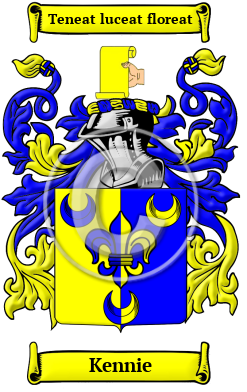
| ![Show Contents]() Kennie History, Family Crest & Coats of Arms Kennie History, Family Crest & Coats of Arms
Etymology of KennieWhat does the name Kennie mean? The Kennie surname in Ireland comes from the Gaelic Ó Coinnigh, which was an old Irish first name, made popular by a 6th century monk of the name, whose "church of Coinneach" became the name of the town Kilkenny. Early Origins of the Kennie familyThe surname Kennie was first found in counties Galway and Roscommon (Irish: Ros Comáin) located in central Ireland in the province of Connacht. Early History of the Kennie familyThis web page shows only a small excerpt of our Kennie research. Another 99 words (7 lines of text) are included under the topic Early Kennie History in all our PDF Extended History products and printed products wherever possible. Kennie Spelling VariationsJust like the English language, the Gaelic language of Ireland was not standardized in the Middle Ages. Therefore, one's name was often recorded under several different spellings during the life of its bearer. Spelling variations revealed in the search for the origins of the Kennie family name include Kenny, O'Kenny, Kenney, Kennie and others. Early Notables of the Kennie familyMore information is included under the topic Early Kennie Notables in all our PDF Extended History products and printed products wherever possible.
| Kennie migration to the United States | + |
Ireland became inhospitable for many native Irish families in the 19th centuries. Poverty, lack of opportunities, high rents, and discrimination forced thousands to leave the island for North America. The largest exodus of Irish settlers occurred with the Great Potato Famine of the late 1840s. For these immigrants the journey to British North America and the United States was long and dangerous and many did not live to see the shores of those new lands. Those who did make it were essential to the development of what would become two of the wealthiest and most powerful nations of the world. These Irish immigrants were not only important for peopling the new settlements and cities, they also provided the manpower needed for the many industrial and agricultural projects so essential to these growing nations. Immigration and passenger lists have documented the arrival of various people bearing the name Kennie to North America:
Kennie Settlers in United States in the 17th Century- John Kennie, who arrived in Perth Amboy, NJ in 1685 1
Kennie Settlers in United States in the 19th Century- Robert Kennie, aged 30, who landed in New York in 1812 1
- John Kennie, aged 28, who settled in America, in 1894
Kennie Settlers in United States in the 20th Century- John Kennie, aged 51, who immigrated to the United States, in 1918
- John Kennie, aged 30, who landed in America, in 1920
| Kennie migration to New Zealand | + |
Emigration to New Zealand followed in the footsteps of the European explorers, such as Captain Cook (1769-70): first came sealers, whalers, missionaries, and traders. By 1838, the British New Zealand Company had begun buying land from the Maori tribes, and selling it to settlers, and, after the Treaty of Waitangi in 1840, many British families set out on the arduous six month journey from Britain to Aotearoa to start a new life. Early immigrants include: Kennie Settlers in New Zealand in the 19th Century- James A. C. Kennie a farmer, who arrived in Auckland, New Zealand aboard the ship "Romulus" in 1862
| Contemporary Notables of the name Kennie (post 1700) | + |
- George Kennie (1904-1994), English first-class cricketer
The motto was originally a war cry or slogan. Mottoes first began to be shown with arms in the 14th and 15th centuries, but were not in general use until the 17th century. Thus the oldest coats of arms generally do not include a motto. Mottoes seldom form part of the grant of arms: Under most heraldic authorities, a motto is an optional component of the coat of arms, and can be added to or changed at will; many families have chosen not to display a motto.
Motto: Teneat luceat floreat
Motto Translation: May it hold an shine.
- Filby, P. William, Meyer, Mary K., Passenger and immigration lists index : a guide to published arrival records of about 500,000 passengers who came to the United States and Canada in the seventeenth, eighteenth, and nineteenth centuries. 1982-1985 Cumulated Supplements in Four Volumes Detroit, Mich. : Gale Research Co., 1985, Print (ISBN 0-8103-1795-8)
 |