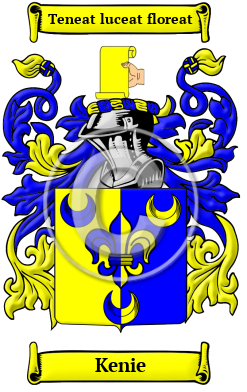
The Kenie surname in Ireland comes from the Gaelic Ó Coinnigh, which was an old Irish first name, made popular by a 6th century monk of the name, whose "church of Coinneach" became the name of the town Kilkenny.
Loading...
Early Origins of the Kenie family
The surname Kenie was first found in counties Galway and Roscommon (Irish: Ros Comáin) located in central Ireland in the province of Connacht.
Early History of the Kenie family
This web page shows only a small excerpt of our Kenie research. Another 99 words (7 lines of text) are included under the topic Early Kenie History in all our PDF Extended History products and printed products wherever possible.
Kenie Spelling Variations
A name was often recorded during the Middle Ages under several different spelling variations during the life of its bearer because literacy was rare there was no real push to clearly define any of the languages found in the British Isles at that time. Variations found of the name Kenie include Kenny, O'Kenny, Kenney, Kennie and others.
Early Notables of the Kenie family
More information is included under the topic Early Kenie Notables in all our PDF Extended History products and printed products wherever possible.
Loading...
Loading...
Loading...
Loading...
Migration of the Kenie family
Death and immigration greatly reduced Ireland's population in the 19th century. For the native Irish people poverty, hunger, and racial prejudice was common. Therefore, thousands left their homeland to seek opportunity in North America. Those who survived the journey and the quarantine camps to which they arrived, were instrumental towards building the strong developing nations of the United States and the future Canada. By far, the largest influx of Irish settlers occurred with Great Potato Famine during the late 1840s. These were employed as construction or factory workers. An examination of passenger and immigration lists has shown early immigrants bearing the name Kenie: Edmund Kenny, who settled in Virginia in 1635; John Kenny, who settled in Virginia in 1771; Richard Kenny, who settled in Virginia in 1637; as well as Daniel, Francis, James, John, Michael, Patrick, Richard, Thomas, and William Kenny, who all arrived in Philadelphia between 1840 and 1860..
The motto was originally a war cry or slogan. Mottoes first began to be shown with arms in the 14th and 15th centuries, but were not in general use until the 17th century. Thus the oldest coats of arms generally do not include a motto. Mottoes seldom form part of the grant of arms: Under most heraldic authorities, a motto is an optional component of the coat of arms, and can be added to or changed at will; many families have chosen not to display a motto.
Motto: Teneat luceat floreat Motto Translation: May it hold an shine.
Remove Item
WARNING!
Removing this item from your shopping cart will remove your associated sale items.
Are you sure you want to delete this item from your shopping cart?
HouseofNames E-Newsletter Sign Up
On Demand Gifts | Digital Products Available 24/7
A Gift for Everyone on your List is a Click Away - Shop Now