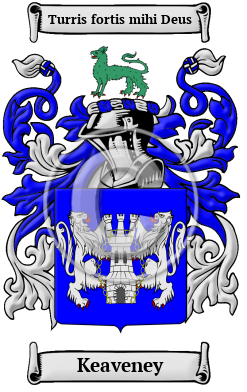
| ![Show Contents]() Keaveney History, Family Crest & Coats of Arms Keaveney History, Family Crest & Coats of Arms
- Origins Available:
Ireland
Etymology of KeaveneyWhat does the name Keaveney mean? The surname Keaveney comes from the original Irish Gaelic name Ó Geibheannaigh or Mac Geibheannaigh. 1 Early Origins of the Keaveney familyThe surname Keaveney was first found in County Galway (Irish: Gaillimh) part of the province of Connacht, located on the west coast of the Island, which is the principal homeland of the sept O Geibheannaigh. The O Geibheannaigh sept belonged to the Ui Maine (Hy Many) and descended from Geibheannach, the son of a Hy Many chief slain in 971. There was also a County Fermanagh sept called Mac Geibheannaigh mentioned in the Annals of Loch Ce in 1308. Early History of the Keaveney familyThis web page shows only a small excerpt of our Keaveney research. Another 73 words (5 lines of text) covering the years 1590 and 1599 are included under the topic Early Keaveney History in all our PDF Extended History products and printed products wherever possible. Keaveney Spelling VariationsSpelling variations of this family name include: Keaveney, Keveney, Kevany, Geaveny, Geaney, Geane, Gaine, Gainey, O'Keaveney, O'Geaney and many more. Early Notables of the Keaveney family- the Keaveney family of Galway
| Keaveney migration to the United States | + |
Keaveney Settlers in United States in the 19th Century- Thomas Keaveney, who arrived in New York in 1854
- Thomas Keaveney, aged 25, who arrived in New York in 1854 2
| Contemporary Notables of the name Keaveney (post 1700) | + |
- Colm Keaveney (b. 1971), Irish politician and Chairman of the Labour Party
- Patrick "Paddy" Keaveney (1929-1995), Irish Cooperative manager from County Donegal and politician in the Independent Fianna Fáil party
- Cecilia Keaveney (b. 1968), Irish former Fianna Fáil politician
- James "Jimmy" Keaveney (b. 1945), Irish former Gaelic footballer from Dublin
- Anna Keaveney (1949-2004), English actress, best known for her role as Marie Jackson in the soap opera Brookside
- Raymond Keaveney, Director of the National Gallery of Ireland
The motto was originally a war cry or slogan. Mottoes first began to be shown with arms in the 14th and 15th centuries, but were not in general use until the 17th century. Thus the oldest coats of arms generally do not include a motto. Mottoes seldom form part of the grant of arms: Under most heraldic authorities, a motto is an optional component of the coat of arms, and can be added to or changed at will; many families have chosen not to display a motto.
Motto: Turris fortis mihi Deus
Motto Translation: God is a tower of strength to me.
- MacLysaght, Edward, Supplement to Irish Families. Baltimore: Genealogical Book Company, 1964. Print.
- Filby, P. William, Meyer, Mary K., Passenger and immigration lists index : a guide to published arrival records of about 500,000 passengers who came to the United States and Canada in the seventeenth, eighteenth, and nineteenth centuries. 1982-1985 Cumulated Supplements in Four Volumes Detroit, Mich. : Gale Research Co., 1985, Print (ISBN 0-8103-1795-8)
 |