| ![Show Contents]() Humphre History, Family Crest & Coats of Arms Humphre History, Family Crest & Coats of Arms
Etymology of HumphreWhat does the name Humphre mean? The Humphre surname comes from the Old French personal name Humfrey, a cognate of the Old German names Hunfrid and Humfrid. This name was originally derived from the Germanic elements "hun," which means "bear cub," and "frid" or "fred," which mean "peace." It was borne by a 9th century saint and Bishop of Therouanne, who was popular among Norman settlers of England. 1 Early Origins of the Humphre familyThe surname Humphre was first found in the Domesday Book of 1086, where early Latin forms of the name were first used: Hunfridus, Humfridus. 2 Many records at this time were a mixture of Latin and Old English. Humfridus was recorded in Suffolk in 1186-1188, but by the 13th century records were often in English, as seen by William Humfrey, who was recorded in Bedfordshire in 1240. William Humfray, Umfrey was found in the Assize Rolls for Staffordshire in 1293 and a few years later, Roger Houmfrey was recorded in 1311. 3 The name is "rarely found north of a line drawn from the Wash to the Dee. Humphrey is confined to the eastern half of the area, in Berks, Norfolk, Surrey, Sussex, etc. Humphreys characterizes the western half, being most numerous in North Wales, and after that in Shropshire, Gloucestershire, Wiltshire, etc. Both are rare or absent in the four south-western counties." 4 The Hundredorum Rolls of 1273 had mixed entries for name as a forename and a surname in a wide variety of spellings: John Hunfray, Oxfordshire; Henry filius Umfridi, Oxfordshire; Peter Umfry, Oxfordshire; Umfrey le Gerische, Oxfordshire; and Richard Humfrey, Oxfordshire. 5 Early History of the Humphre familyThis web page shows only a small excerpt of our Humphre research. Another 87 words (6 lines of text) covering the years 1069, 1391, 1447, 1579, 1621, 1647, 1648, 1662, 1674, 1701, 1712, 1714, 1719, 1735 and 1890 are included under the topic Early Humphre History in all our PDF Extended History products and printed products wherever possible. Humphre Spelling VariationsAlthough there are comparatively few Welsh surnames, they have a great many spelling variations. Variations of Welsh names began almost immediately after their acceptance within Welsh society. In the Middle Ages, it was up to priests and the few other people that recorded names in official documents to decide how to spell the names that they heard. Variations that occurred because of improper recording increased dramatically as the names were later transliterated into English. The Brythonic Celtic language of Wales, known by natives as Cymraeg, featured many highly inflected sounds that could not be properly captured by the English language. Spelling variations were, however, also carried out according to an individual's design: a branch loyalty within the family, a religious adherence, or even patriotic affiliations were all indicated by the particular variation of one's name. The spelling variations of the name Humphre have included Humphreys, Homfray, Humfrey, Humfrie, Humfries, Humfreys, Humphereys, Humphries, Humphrays, Humphray, Humphrey, Humphris, Humphry, Humphryes and many more. Early Notables of the Humphre family- Humphrey (1391-1447), the son of King Henry IV, who was Duke of Gloucester and Earl of Pembroke, and also a patron of letters
- Sir William Humphreys, Lord Mayor of London in 1714
- Humphrey Humphreys (1648-1712), Welsh clergyman, Bishop of Bangor and of Hereford (1701-1712)
Migration of the Humphre family to IrelandSome of the Humphre family moved to Ireland, but this topic is not covered in this excerpt.
Another 57 words (4 lines of text) about their life in Ireland is included in all our PDF Extended History products and printed products wherever possible. Migration of the Humphre familyThe Welsh began to emigrate to North America in the late 1800s and early 1900s in search of land, work, and freedom. Those that arrived helped shape the industry, commerce, and the cultural heritage of both Canada and the United States. The records regarding immigration and passenger show a number of people bearing the name Humphre: Richard Humfrey, who was one of the settlers left at Roanoke, Virginia in 1584 by Sir Walter Raleigh; John Humfrey, who was on record in Massachusetts in 1629.
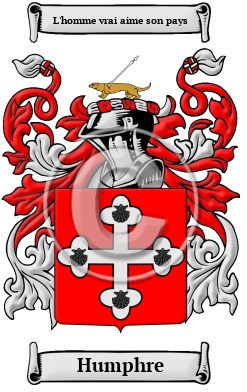
The motto was originally a war cry or slogan. Mottoes first began to be shown with arms in the 14th and 15th centuries, but were not in general use until the 17th century. Thus the oldest coats of arms generally do not include a motto. Mottoes seldom form part of the grant of arms: Under most heraldic authorities, a motto is an optional component of the coat of arms, and can be added to or changed at will; many families have chosen not to display a motto.
Motto: L'homme vrai aime son pays
Motto Translation: The true man loves his country.
- Dixon, Bernard Homer, Surnames. London: John Wilson and son, 1857. Print
- Williams, Dr Ann. And G.H. Martin, Eds., Domesday Book A Complete Translation. London: Penguin, 1992. Print. (ISBN 0-141-00523-8)
- Reaney, P.H and R.M. Wilson, A Dictionary of English Surnames. London: Routledge, 1991. Print. (ISBN 0-415-05737-X)
- Guppy, Henry Brougham, Homes of Family Names in Great Britain. 1890. Print.
- Bardsley, C.W, A Dictionary of English and Welsh Surnames: With Special American Instances. Wiltshire: Heraldry Today, 1901. Print. (ISBN 0-900455-44-6)
 |